
Have you ever watched your child sit at the kitchen table, staring at homework that used to feel easy, and wondered what changed? For many Texas families, the answer is not laziness or lack of effort. It is stress. It is uncertainty. It is the quiet weight children carry when their parents are navigating a Texas Contested Divorce.
A Texas Contested Divorce is more than a legal disagreement about custody or property. It is a process governed by the Texas Family Code, including §153.002, which requires courts to focus on the “best interest of the child.” That legal standard does not exist in a vacuum. Judges often look closely at a child’s academic stability, emotional development, and daily routine when making conservatorship decisions. In other words, what happens in the courtroom can directly affect what happens in the classroom.
At The Law Office of Bryan Fagan, PLLC, we understand this intersection deeply. Founded by Bryan Joseph Fagan, a South Texas College of Law graduate and recognized authority in Texas divorce and custody law, our firm has guided thousands of families through contested cases across Houston and throughout Texas. We have seen firsthand how litigation stress can disrupt report cards, confidence, and focus. We have also seen how thoughtful legal strategy and compassionate counsel can restore stability and help children thrive again.
Our mission is simple but powerful: to empower people to reclaim freedom and peace of mind during life’s hardest transitions. We do that by educating families about their rights, simplifying complex legal procedures, and crafting custody solutions that protect what matters most. When parents understand how Texas courts evaluate academic continuity, parenting involvement, and school stability, they make stronger decisions. Knowledge reduces fear. Structure restores calm.
If you are facing a Texas Contested Divorce and worrying about how it may affect your child’s performance in school, you are not alone. In this article, you will learn how Texas judges weigh educational stability, what practical steps you can take right now to support your child, and how experienced legal guidance can safeguard both your parental rights and your child’s academic future.
Divorce may change your family’s structure, but it does not have to define your child’s success. Let’s take a closer look at how the law, when approached with clarity and compassion, can help your family move forward with confidence.
Key Takeaways
- A contested divorce occurs when spouses cannot reach a complete agreement on one or more major issues—custody, property division, child support, or spousal maintenance
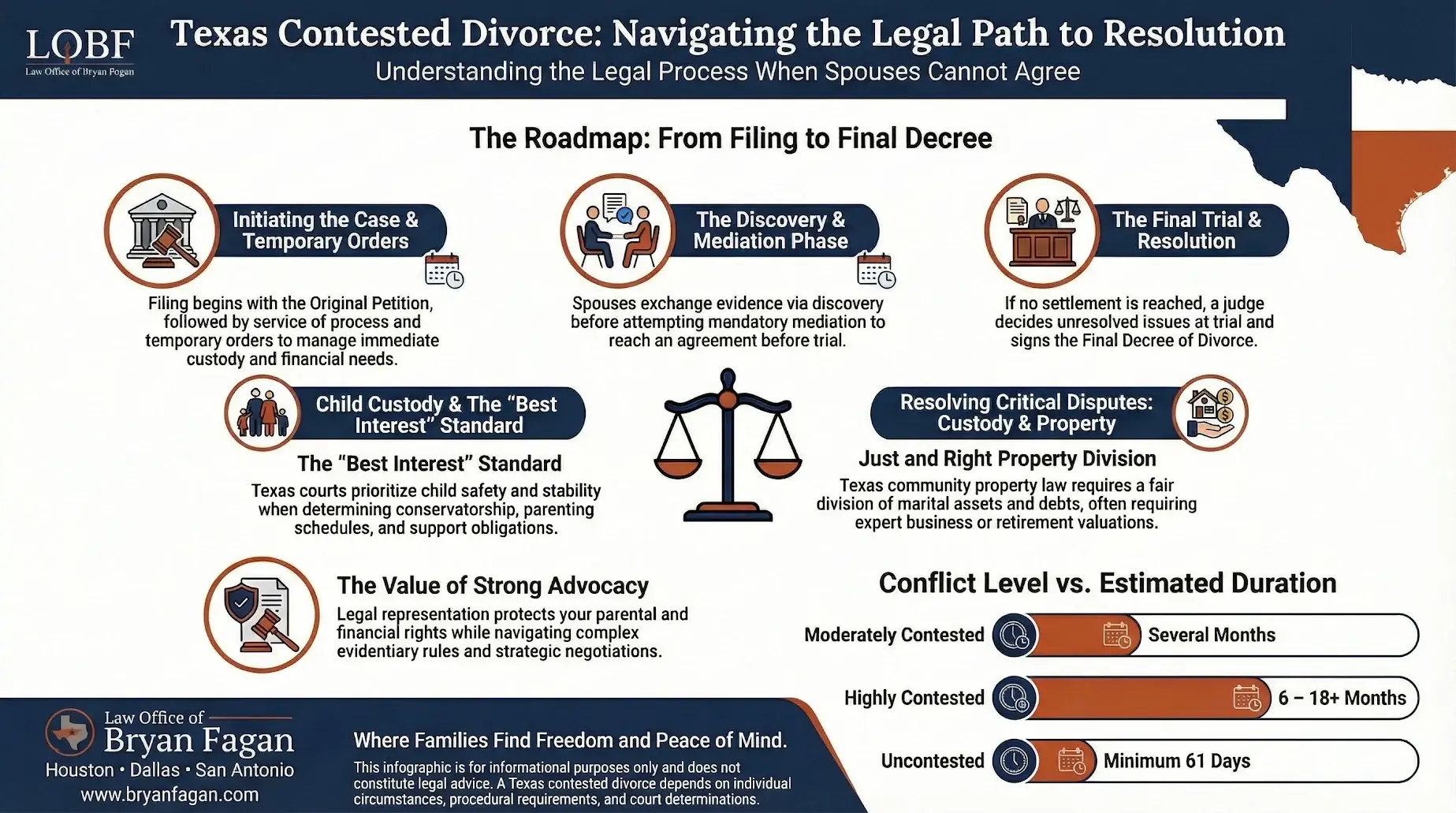
- The process involves seven distinct steps from filing to trial, typically taking 6-18 months depending on complexity
- Texas Family Code provisions govern residency requirements, mandatory waiting periods, and best interest standards that judges apply
- Temporary orders established early in your case often shape the final outcome and require immediate strategic attention
- Most divorces settle through mediation before trial, but preparation for litigation remains essential throughout

Your Family’s Future Starts Here
Don’t navigate your legal journey alone. Schedule a consultation now and get the clarity and support you deserve.
Texas Contested Divorce: The Short Answer
Under Texas law, a texas contested divorce arises when spouses cannot reach agreement on one or more essential issues required to finalize their marriage. While Texas allows no-fault divorce under Texas Family Code §6.001 (insupportability), disputes over conservatorship and possession under Chapter 153, child support under Chapter 154, spousal maintenance under Chapter 8, or the division of community property under Chapter 7 shift the case into formal litigation. Unlike an uncontested divorce—where both parties sign a complete settlement agreement—a contested matter moves through structured legal stages governed by the Texas Rules of Civil Procedure, including temporary orders, discovery, mediation, and possibly trial. For a comprehensive breakdown of these stages, you can review our detailed guide on the contested divorce process in Texas.
When children are involved, Texas courts must apply the “best interest of the child” standard under Texas Family Code §153.002. Judges evaluate parental involvement, emotional stability, educational continuity, and each parent’s ability to provide a safe, consistent home. Under §153.134, when parents are appointed Joint Managing Conservators, the court must determine which parent has the exclusive right to designate the child’s primary residence. That decision often impacts school placement, daily routines, and long-term stability. Recent updates to Texas child support laws under Chapter 154, including adjustments to the net resources cap, further demonstrate the Legislature’s ongoing effort to ensure financial protections reflect modern economic realities.
Property division in a texas contested divorce is governed by Texas Family Code §7.001, which requires a “just and right” division of community property. This does not necessarily mean an equal split. Courts may consider fault grounds under §§6.002–6.007, disparities in earning capacity, reimbursement claims, and evidence of financial misconduct. Retirement accounts may require carefully drafted Qualified Domestic Relations Orders, and business interests may involve professional valuation. Even a single unresolved issue—whether involving the marital residence, retirement benefits, or a parenting schedule—places the entire case within contested status until resolved by agreement or judicial decision.
At The Law Office of Bryan Fagan, PLLC, our Texas family law team believes clarity reduces fear and preparation restores control. We guide families through the litigation process with education, strategic advocacy, and compassionate communication. For additional insight into how courts determine financial obligations and enforce support, we invite you to explore our Texas Child Support Resource Center, which provides updated legal guidance grounded in current statutory standards.
A contested divorce does not mean chaos—it means the court provides a structured pathway to resolution when agreement is not possible. With experienced counsel grounded in the Texas Family Code and a strategy designed to protect what matters most, you can move forward with confidence, stability, and peace of mind.

What Makes a Divorce Contested in Texas?
Several circumstances can shift a cooperative separation into a texas contested divorce, and understanding those triggers helps families prepare strategically rather than react emotionally. In many cases, the most sensitive disputes involve child custody and parenting time. When both parents seek the exclusive right to designate the child’s primary residence under Texas Family Code §153.134, or when one parent proposes relocation that would alter a geographic restriction, the court must apply the “best interest of the child” standard found in §153.002. Judges closely examine stability, parental involvement, and the child’s emotional and educational needs before making conservatorship decisions. Even well-intentioned parents can find themselves at odds when they believe they are advocating for their child’s future.
Property disputes also frequently move a divorce into contested status. Texas is a community property state under Texas Family Code §3.002, meaning assets acquired during marriage are presumed to belong to both spouses. However, characterizing property as separate under §3.001 requires clear and convincing evidence, and disagreements over tracing, reimbursement claims, business valuations, or retirement accounts can quickly escalate. Courts divide community property in a manner that is “just and right” under §7.001, which does not necessarily mean equal. Updated case law and statutory refinements continue to reinforce judicial discretion in evaluating earning capacity, fault grounds under §§6.002–6.007, and financial misconduct.
Child support disagreements are another common catalyst for a texas contested divorce. Under Chapter 154 of the Texas Family Code, courts calculate support based on guideline percentages tied to the obligor’s net resources. Recent legislative updates have increased the net resource cap used for calculating guideline child support, reflecting economic realities and inflation adjustments. Disputes often arise over income calculations, self-employment earnings, healthcare coverage, or requests to deviate from the guidelines. Our firm’s comprehensive Texas Child Support Resource explains how these calculations work and how courts evaluate deviations.
Spousal maintenance disagreements under Chapter 8 can also intensify conflict. One spouse may assert eligibility based on the statutory duration requirements and demonstrated inability to meet minimum reasonable needs, while the other contests qualification or amount. Courts must evaluate factors outlined in §8.052, including financial resources, education, employment skills, and contributions to the marriage.
In some situations, refusal to negotiate in good faith forces litigation. Allegations of fault such as cruelty (§6.002) or adultery (§6.003) may influence property division and increase tension. Even a single unresolved disagreement—whether about custody, support, or assets—transforms the case into contested status and places the outcome in the hands of the court.
At The Law Office of Bryan Fagan, PLLC, our Texas family law team believes that education reduces uncertainty and preparation restores confidence. While divorce litigation is distinct from estate disputes, the principles of contesting filed information share procedural similarities, which we explore further in our article on how to challenge information filed in a Texas probate matter. Just as in probate, contested family law matters require careful documentation, adherence to statutory standards, and strategic advocacy.
The critical takeaway is this: even one unresolved issue can shift your case into a texas contested divorce, requiring court intervention and structured legal proceedings. With experienced guidance grounded in the Texas Family Code and a commitment to protecting your family’s future, you can approach contested litigation with clarity, preparation, and peace of mind.

Step 1: Filing the Original Petition for Divorce
The contested divorce process begins when one spouse files the Original Petition for Divorce in the appropriate Texas district court. Under Texas Family Code §6.301, at least one spouse must have resided in Texas for the preceding six months and in the filing county for the last 90 days before filing.
The petition formally initiates your family law case, identifying both parties, establishing grounds for divorce (typically insupportability, meaning irreconcilable differences in this no fault divorce state), and outlining requested relief regarding custody, support, and property.
Once you file the divorce petition, the 60-day waiting period mandated by Texas Family Code §6.702 begins running. This waiting period cannot be shortened except in protective order situations. However, contested cases extend far beyond 60 days due to the litigation process that follows.
Filing also typically triggers automatic temporary restraining orders that preserve the status quo—preventing either spouse from dissipating marital assets, hiding property, or disrupting existing custody arrangements while the case proceeds.
Step 2: Service of Process and Response
After filing, your spouse must receive formal notice through service of process. Texas Rules of Civil Procedure require delivery by a process server, constable, or certified mail, ensuring due process protections.
The other spouse then has 20 days plus the following Monday to file an answer with the clerk’s office. This deadline matters critically—failure to respond timely can result in a default divorce where the court grants the filing spouse’s requests without the absent party’s input.
In most contested cases, the respondent files an answer and often a counter-petition asserting their own claims. A spouse signs the answer to preserve their right to contest issues and seek different outcomes than what the original petition requested.
For cooperative parties who simply disagree on specific issues, waiver of service allows the respondent to accept papers voluntarily, accelerating the timeline slightly.
Step 3: Temporary Orders in Contested Cases
Immediately following the initial filings, either party may file a Motion for Temporary Orders. These orders govern how your family operates while the divorce case winds through the legal process—often for many months.
Temporary orders address:
- Temporary child custody arrangements establishing which parent has primary possession
- Child support amounts calculated per statutory guidelines
- Exclusive use of the marital residence—one spouse may be ordered to vacate
- Bill payments and financial responsibilities during litigation
- Temporary restraining order provisions preventing misconduct
The temporary orders hearing functions as a mini-trial where both sides present evidence and testimony. The judge’s decisions remain binding until the Final Decree of Divorce.
Here’s what experienced family law attorneys understand: temporary orders often predict final outcomes. Judges hesitate to disrupt arrangements that appear to be working. If you receive unfavorable temporary orders, you’ll fight an uphill battle changing them at trial. Approach temporary orders strategically from day one.
Step 4: The Discovery Phase
In a texas contested divorce, discovery is one of the most important phases of litigation because it allows both parties to gather the information necessary for meaningful negotiation or effective trial preparation. Governed by the Texas Rules of Civil Procedure, discovery ensures transparency and fairness when disputes arise over conservatorship under Chapter 153, child support under Chapter 154, spousal maintenance under Chapter 8, or property division under Chapter 7 of the Texas Family Code. Without complete and accurate information, courts cannot apply the “just and right” standard in §7.001 or determine the best interest of the child under §153.002.
One of the foundational components of discovery is the sworn Inventory and Appraisement. Each spouse must disclose all community property as defined under §3.002, identify any separate property claims under §3.001, and list outstanding debts. These disclosures are made under oath. Attempting to conceal assets or misrepresent financial information can result in sanctions, adverse rulings, or even perjury consequences. Full transparency not only protects your credibility but also strengthens your position before the court.
Discovery tools also include interrogatories—written questions answered under oath that clarify income sources, asset ownership, and parenting arrangements. Requests for production compel the exchange of key documents such as tax returns, bank statements, employment records, retirement account statements, and relevant communications. In custody disputes, these materials may demonstrate involvement in school, healthcare decisions, and daily parenting responsibilities. Depositions allow attorneys to question parties or witnesses under oath before trial, preserving testimony and assessing credibility.
In more complex cases, expert witnesses often play a critical role. A forensic accountant may analyze business interests or trace separate property claims. A custody evaluator may provide recommendations concerning conservatorship and possession consistent with §153.134. Recent updates to Texas child support law, including adjustments to the net resource cap used for guideline calculations under Chapter 154, make accurate income evaluation even more significant in high-income cases. For additional insight into how courts determine and enforce financial obligations, we encourage you to review our Texas Child Support Resource.
Discovery deadlines are not optional. Courts enforce compliance through motions to compel and, when necessary, sanctions that may limit evidence or strike pleadings. This structured accountability is similar to other contested legal matters, including estate litigation, which we discuss in our guide on contesting a will in Texas. While divorce and probate proceedings differ substantively, both rely on procedural rigor and evidentiary precision.
At The Law Office of Bryan Fagan, PLLC, our Texas family law team approaches discovery with strategy and purpose. We believe education reduces uncertainty and preparation restores confidence. A texas contested divorce can feel overwhelming, but with organized documentation, skilled advocacy, and a clear understanding of your rights under the Texas Family Code, discovery becomes a powerful tool rather than a source of stress.

Step 5: Mediation Requirements
Texas courts frequently order mediation before allowing a contested divorce to proceed to trial. Mediation offers a confidential setting where a neutral mediator facilitates negotiation between the parties.
The mediator doesn’t decide your case—they help identify common ground and craft creative solutions. If you reach a complete agreement or resolve some issues, you’ll sign a Mediated Settlement Agreement (MSA). Under Texas Family Code §6.602, a properly executed MSA is binding and irrevocable, meaning you cannot later change your mind about terms you agreed to in mediation.
Mediation success rates run high—attorneys estimate 70-80% of cases settle at least partially through this process. Settlement avoids trial uncertainty, reduces costs, and allows you to maintain control over outcomes rather than leaving decisions to a judge.
If mediation fails to resolve all issues, your case proceeds toward trial on the remaining disputes.
Step 6: Pre-Trial Motions and Hearings
As trial approaches, procedural matters require attention. Pre-trial motions may include:
Motions to compel when the opposing party fails to provide discovery responses
Motions for continuance requesting additional time due to scheduling conflicts or incomplete preparation
Pre-trial conferences with the court to narrow disputed issues, exchange exhibit lists, and confirm the trial date
This phase involves intensive evidence preparation—authenticating documents, preparing witness testimony, and coordinating expert opinions. Settlement negotiations often intensify as trial costs loom and both parties confront the reality of judicial decision-making.
Step 7: Trial in Texas District Court
If your contested divorce reaches trial, a Texas district court judge—not a jury—decides unresolved issues. (Texas law permits jury trials on property division if demanded, but most divorces proceed as bench trials.)
At trial, both parties present evidence, examine witnesses, and argue their positions. The judge applies specific legal standards:
For custody disputes involving children, Texas Family Code §153.002 requires decisions based on the best interest of the child, considering factors including each parent’s abilities, the child’s emotional and physical needs, stability of proposed living arrangements, and any history of family violence.
For property division, Texas Family Code Chapter 7 requires “just and right” division of community property—not necessarily 50/50. Judges consider factors including fault in the marriage breakdown, disparate earning capacities, waste of community assets, and future needs.
Child support follows statutory guidelines under Chapter 154, typically calculated as a percentage of the obligor’s net resources.
Spousal maintenance eligibility and amount follow Chapter 8 requirements regarding marriage duration and need.
After hearing evidence, the judge renders judgment. The Final Decree of Divorce, once the judge signs it, formally ends your marriage and establishes binding orders on all resolved issues.
Timeline Expectations for Texas Contested Divorce
Understanding realistic timelines can significantly reduce anxiety during a texas contested divorce, especially when emotions are already running high. While every family’s circumstances are unique, the legal framework established by the Texas Family Code provides important guideposts that help set expectations. Under Texas Family Code §6.702, there is a mandatory 60-day waiting period from the date the Original Petition for Divorce is filed before a court can grant a final decree. This statutory cooling-off period establishes the minimum duration of any divorce in Texas, but in contested cases, the process typically extends well beyond that initial threshold.
In most contested matters, resolution occurs within approximately 6 to 18 months from filing to the signing of the Final Decree of Divorce. During this time, courts may address temporary orders under Chapter 105 to establish conservatorship, possession schedules, and child support while the case is pending. If custody is disputed, judges must apply the “best interest of the child” standard under §153.002 and evaluate conservatorship rights outlined in §153.134. Property division disputes are governed by §7.001, which requires a “just and right” division of community property. Each of these statutory requirements adds procedural steps that influence overall timing.
More complex cases can extend beyond 18 to 24 months, particularly when high-conflict custody battles, business valuations, reimbursement claims, or retirement divisions requiring Qualified Domestic Relations Orders are involved. Recent updates to the Texas Family Code, including adjustments to the net resource cap used in child support calculations under Chapter 154, have also increased the need for detailed financial analysis in higher-income cases. If you would like to better understand how financial factors can affect both support and timeline considerations, our Texas Child Support Resource provides additional clarity.
Several practical factors influence how long a texas contested divorce may take, including the scope of discovery, local court dockets, mediation progress, attorney cooperation, and whether either party requests continuances. Counties such as Harris, Fort Bend, and Montgomery may have different scheduling realities depending on case volume. Strategic preparation and organized documentation can significantly streamline the process.
At The Law Office of Bryan Fagan, PLLC, our Texas family law team believes that setting realistic expectations empowers clients to move forward with confidence rather than fear. We guide families step by step through litigation, helping them understand deadlines, procedural requirements, and potential obstacles before they arise. For individuals seeking representation in the Atascocita area, you can learn more about our approach to contested matters by visiting our page on contested divorce representation in Atascocita.
A contested divorce is not a sprint; it is a structured legal process designed to ensure fairness and protect families’ futures. With experienced guidance grounded in the Texas Family Code and a commitment to compassionate communication, even a complex timeline can become manageable and purposeful.

Common Mistakes in Texas Contested Divorce Cases
Avoiding these pitfalls protects your position:
Emotional escalation damages settlement prospects and increases costs. The most favorable outcomes often come through strategic restraint.
Hiding or failing to disclose community assets triggers sanctions and destroys credibility with the court.
Ignoring court deadlines for pleadings and discovery can result in default judgment or evidence exclusion.
Underestimating temporary orders sets unfavorable precedents that become difficult to reverse.
Refusing good faith mediation participation may result in cost-shifting and judicial frustration.
Poor deposition preparation allows opposing counsel to damage your credibility before trial.
Financial and Emotional Costs of Contested Divorce
A texas contested divorce requires thoughtful financial and emotional preparation because litigation involves more than filing paperwork and attending court hearings. When spouses cannot resolve disputes involving conservatorship under Texas Family Code Chapter 153, child support under Chapter 154, spousal maintenance under Chapter 8, or the division of community property under Chapter 7, the legal process becomes more detailed and resource-intensive. While every case is different, attorney’s fees in contested matters often range from $15,000 to $50,000 or more depending on complexity, discovery demands, and whether the case proceeds to trial. Experienced family law attorneys typically bill hourly, and extended litigation can increase overall costs.
Expert witnesses can also significantly impact the financial scope of a case. Business valuation professionals may be necessary when dividing closely held companies under §7.001’s “just and right” standard. Custody evaluators may be appointed in high-conflict cases to assess the child’s best interest under §153.002. Forensic accountants may analyze tracing claims under §3.001 and §3.002 when one spouse asserts separate property interests. Each of these professionals brings specialized expertise that strengthens evidentiary presentation but also adds to litigation expenses.
Court-related costs should also be considered. Filing fees, deposition transcripts, mediation sessions, and document preparation expenses can collectively exceed several thousand dollars. Updated statutory adjustments to the child support net resource cap under Chapter 154 have further increased the need for precise income analysis in higher-income cases, sometimes requiring additional financial documentation or expert review. For a clearer understanding of how support is calculated and enforced, our firm’s Texas Child Support Resource offers practical guidance grounded in current law.
Beyond financial considerations, the emotional cost of a texas contested divorce can be significant. Extended litigation often creates stress for both spouses and children, especially when disputes involve conservatorship or relocation. Strategic decision-making becomes essential. In some situations, settlement through mediation provides greater certainty and emotional relief than continued courtroom conflict. A careful cost-benefit analysis—evaluating both legal outcomes and personal well-being—often helps families determine when negotiation may serve them better than prolonged litigation.
At The Law Office of Bryan Fagan, PLLC, our Texas family law team emphasizes education and proactive planning so clients understand both the legal and practical realities of contested divorce. We believe informed decisions protect futures. For families in South Texas seeking local guidance, you can learn more about our approach to contested litigation by visiting our page on contested divorce representation in San Antonio.
Litigation is sometimes necessary to protect your rights, but it should always be approached with clarity, preparation, and a long-term perspective. With experienced counsel and compassionate communication, even complex financial and emotional challenges can be navigated in a way that safeguards stability and peace of mind.

A texas contested divorce demands comprehensive legal guidance at every stage because each decision can affect your children, your financial stability, and your long-term peace of mind. From the initial consultation, strategic case planning establishes clear objectives grounded in Texas Family Code standards, including the “best interest of the child” requirement under §153.002 and the “just and right” property division framework under §7.001. Setting realistic expectations early helps clients understand how statutory timelines, including the mandatory 60-day waiting period under §6.702, and court procedures will shape the path forward.
Effective representation also requires thorough evidence development. Proper documentation of community property under §3.002 and separate property claims under §3.001 is essential, particularly when tracing assets or addressing reimbursement claims. In cases involving children, detailed records of parental involvement, school participation, and caregiving responsibilities can significantly influence conservatorship determinations under §153.134. With recent updates to Texas child support guidelines under Chapter 154, including adjustments to the net resource cap used in support calculations, accurate financial documentation is more important than ever. For additional clarity on how courts calculate and enforce support, our Texas Child Support Resource offers practical guidance grounded in current law.
Custody advocacy in a texas contested divorce centers on demonstrating your commitment to your children’s stability and well-being. Judges evaluate consistency, communication, and each parent’s ability to foster a positive co-parenting environment. Our legal team works to present evidence that aligns with statutory best-interest factors while preparing strategically for mediation and, if necessary, trial.
Strong settlement positioning remains a priority throughout litigation. Even as we prepare thoroughly for courtroom advocacy, we evaluate opportunities for negotiated resolution that protect your rights while reducing emotional and financial strain. When trial becomes necessary, disciplined preparation and persuasive presentation ensure your case is supported by both factual evidence and clear legal authority.
Clear, consistent communication remains central to our mission of educating families and protecting futures. At The Law Office of Bryan Fagan, PLLC, we believe informed clients make empowered decisions. For families in the North Houston area seeking localized insight, you can learn more about our approach by visiting our page on contested divorce cases in Spring, Texas.
A contested divorce is never easy, but with strategic planning, thorough preparation, and compassionate guidance grounded in the Texas Family Code, you can move forward confidently, knowing your future is protected with clarity and purpose.
Why Choose The Law Office of Bryan Fagan, PLLC for Your Contested Divorce
When navigating a texas contested divorce, experience and clarity make a meaningful difference. High-conflict cases often involve disputes over conservatorship under Texas Family Code Chapter 153, property division under Chapter 7, child support under Chapter 154, and spousal maintenance under Chapter 8. Courts must apply the “best interest of the child” standard in §153.002 and divide community property in a manner that is “just and right” under §7.001. These legal standards require more than general familiarity—they demand strategic preparation, evidentiary precision, and an understanding of how recent legislative updates, including adjustments to the child support net resource cap, affect financial determinations.
At The Law Office of Bryan Fagan, PLLC, our Texas family law team combines courtroom readiness with compassionate communication. We prepare each case thoroughly while remaining focused on practical solutions that protect families from unnecessary stress. Our mission is to educate families and protect futures, which means helping you understand each stage of litigation—from the mandatory 60-day waiting period under §6.702 to temporary orders hearings and final decree proceedings. For a clear, step-by-step overview of what to expect, we encourage you to review our comprehensive guide on the Texas divorce process.
Statewide representation allows our firm to tailor strategy to local court procedures and judicial expectations throughout Texas. Whether your matter is filed in Harris County, Bexar County, or elsewhere, our advocacy remains grounded in statutory authority and practical courtroom experience. If your case involves financial complexities such as updated child support calculations under Chapter 154, our Texas Child Support Resource provides additional insight into how courts determine and enforce support obligations.
A contested divorce is one of life’s most difficult transitions, but it does not have to leave you uncertain or overwhelmed. With experienced counsel, thoughtful strategy, and a clear understanding of your rights under the Texas Family Code, you can approach the process with confidence. For additional details about how litigation unfolds and what protections are available to you, explore our in-depth resource on understanding the Texas divorce process.

Checklist: Preparing for Your Texas Contested Divorce
- Gather financial documents including tax returns, bank statements, investment accounts, and retirement account statements
- Create a detailed inventory of marital assets and debts
- Document parenting time, school involvement, and child-related concerns
- Identify separate property acquired before marriage or through inheritance/gift
- Prepare strategically for temporary orders—these often shape final outcomes
- Understand discovery obligations and maintain organized records
- Consider mediation goals and potential settlement terms
- Budget realistically for contested divorce costs and timeline
- Schedule consultation with an experienced Texas divorce attorney
Conclusion
Divorce can feel overwhelming, especially when you see its effects show up in places that matter most — like your child’s classroom. But here’s the truth we’ve seen time and time again: with the right structure, the right mindset, and the right legal guidance, children are remarkably resilient. A Texas Contested Divorce does not have to define your child’s academic future. With thoughtful planning and steady leadership from both parents, stability can return — and often stronger than before.
The key is being proactive rather than reactive. Stay involved in your child’s education. Communicate with teachers. Keep routines consistent. And when legal decisions need to be made, make them with long-term stability in mind, not short-term emotion. Texas courts are guided by the best interest of the child standard for a reason. When parents align their actions with that same principle, powerful things happen.
If you are facing a Texas Contested Divorce and feel unsure about how custody decisions may affect your child’s school performance, you do not have to navigate it alone. Working with an experienced Texas Family Law Attorney can help you understand your options, protect your parental rights, and build a parenting plan that supports your child’s growth both at home and in the classroom.
At The Law Office of Bryan Fagan, PLLC, our mission is to educate families, protect futures, and help you reclaim peace of mind during one of life’s hardest transitions. If you’re ready to move forward with clarity and confidence, we invite you to schedule a consultation and start building a strategy that keeps your child’s well-being at the center of every decision.
Because at the end of the day, this isn’t just about court orders. It’s about report cards, confidence, and giving your child the steady foundation they need to succeed — no matter what changes come your way.
Frequently Asked Questions About Texas Contested Divorce
When you contest a divorce in Texas, it means you and your spouse disagree on one or more major issues such as child custody, property division, child support, or spousal maintenance. Instead of finalizing an agreement quickly, the case moves through litigation stages that may include temporary orders hearings, discovery, mediation, and possibly trial. If you cannot reach a settlement, a judge will decide the unresolved issues based on Texas law, including the “best interest of the child” standard under Texas Family Code §153.002.
The 10-10-10 rule typically applies to military divorces. It refers to situations where the couple was married for at least 10 years, the service member completed at least 10 years of creditable military service, and those 10 years overlapped. If this rule is met, the Defense Finance and Accounting Service (DFAS) can send retirement payments directly to the former spouse. It does not automatically mean the spouse receives 50 percent; it simply affects how payments are distributed.
Moving out of the marital home without a clear temporary orders agreement can create unintended consequences, especially in custody cases. Courts often look at the “status quo” when determining conservatorship and possession schedules. If one parent voluntarily reduces time with the children by leaving the home, that arrangement may influence future custody decisions. Before making any major move, it is wise to speak with an experienced Texas family law attorney.
A contested divorce in Texas typically takes between 6 and 18 months. While the law requires a minimum 60-day waiting period from filing, most contested cases extend well beyond that due to discovery, mediation, court scheduling, and possible trial preparation. Highly complex cases involving business valuations or high-conflict custody disputes may take longer.
Avoid hiding assets, violating court orders, making large financial changes without legal advice, or speaking negatively about your spouse to your children. Judges pay close attention to credibility, cooperation, and stability. Social media posts, financial records, and communication patterns can all become evidence in a contested case.
There is no single formula for “winning” a contested divorce, but preparation and strategy matter. Success often depends on presenting credible evidence, demonstrating active involvement in your children’s lives, maintaining financial transparency, and aligning your requests with Texas legal standards. Working with an experienced Texas family law attorney significantly improves your ability to navigate complex litigation effectively.
The four C’s commonly referenced in divorce discussions are communication, cooperation, compromise, and consistency. In contested custody cases especially, courts value parents who show they can communicate respectfully, cooperate when possible, compromise in good faith, and maintain consistent routines for their children.
Social Security benefits are governed by federal law and are not divided as community property in a Texas divorce. However, a former spouse may qualify to receive derivative benefits based on the other spouse’s earnings record if the marriage lasted at least 10 years and certain federal eligibility requirements are met.
A 70/30 divorce split refers to a disproportionate division of community property, where one spouse receives 70 percent and the other receives 30 percent. Texas courts divide community property in a “just and right” manner, which does not always mean a 50/50 split. Judges may award a disproportionate share based on factors such as fault in the breakup of the marriage, differences in earning capacity, or financial misconduct involving community assets.