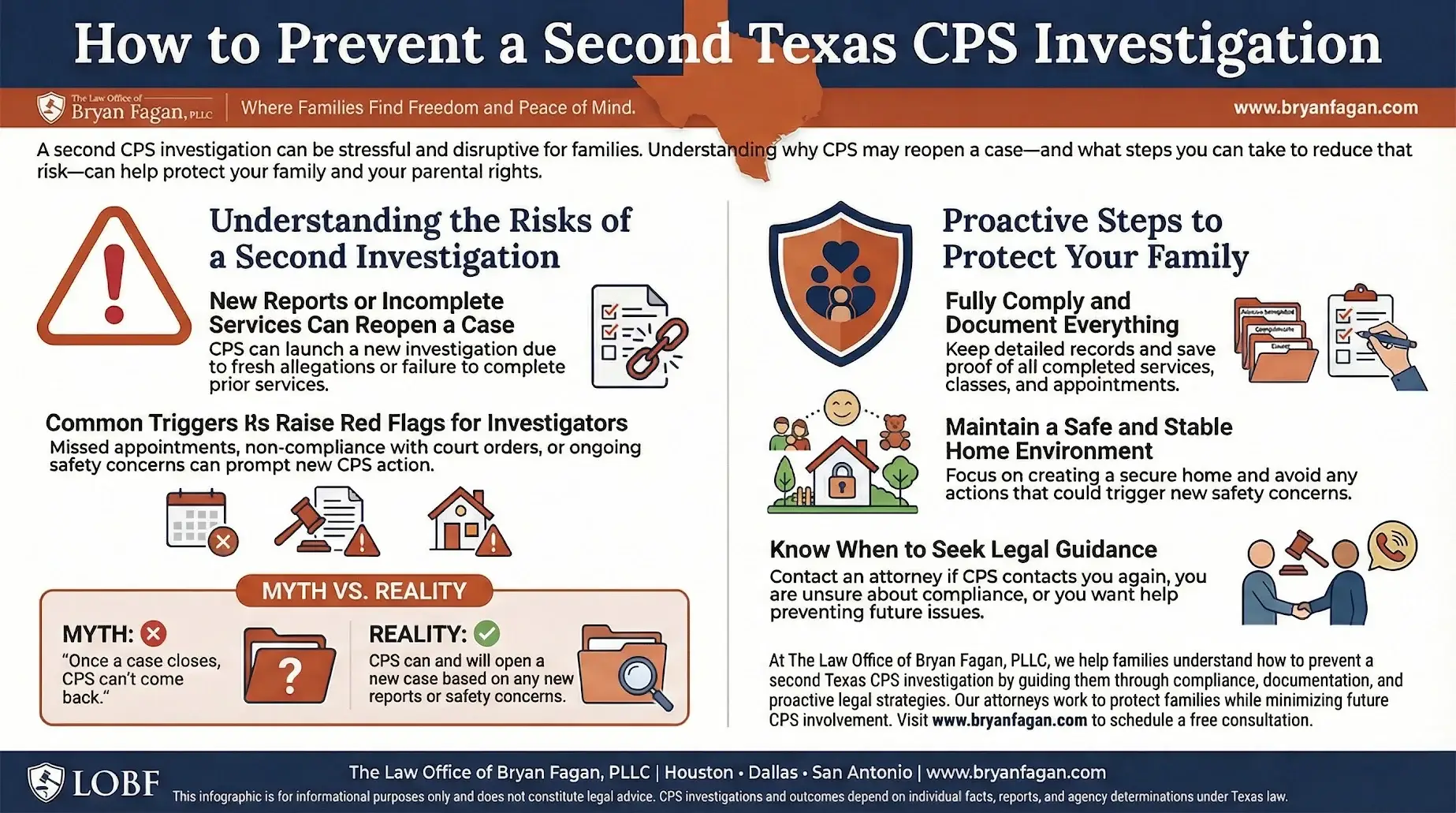

How to Prevent a Second Texas CPS Investigation is a question many parents never expect to ask themselves—until a knock at the door, a call from a school counselor, or a sudden change in their child’s behavior brings old fears rushing back. Divorce is already one of the most emotionally disruptive experiences a family can face, and when CPS has been involved before, even small parenting missteps or academic struggles can feel terrifying. If you’ve found yourself lying awake at night worrying that one bad report card, one missed school day, or one misunderstanding could reopen a CPS case, you are not alone—and you are not powerless.
At The Law Office of Bryan Fagan, PLLC, we see this fear every day in Houston families navigating divorce, custody, and the long shadow of prior CPS involvement. Texas law makes it clear under Texas Family Code §153.002 that every decision involving children must center on their best interests, and Texas judges often look closely at academic stability when evaluating custody and parenting arrangements. When a child’s grades slip or school routines fall apart during or after a divorce, those changes can attract attention not just from the court, but from mandated reporters who are legally required to act on concerns. Understanding how these systems intersect is one of the most important steps parents can take to protect their children—and their peace of mind.
Led by Bryan Joseph Fagan, a South Texas College of Law graduate and recognized authority on Texas divorce and custody law, our firm is built on a simple belief: families deserve clarity during life’s hardest transitions. We don’t just explain the law—we help parents understand how real-life issues like co-parenting schedules, school performance, and emotional stress can quietly increase the risk of renewed CPS scrutiny. In this article, you’ll learn how divorce affects children’s academic performance, why schools play a critical role in CPS reporting, and what proactive steps Texas parents can take to safeguard their family’s future.
Most importantly, this guide is about empowerment. Knowledge replaces fear. Preparation restores confidence. As you read on, you’ll gain practical insight, legal context, and reassurance that with the right guidance, it is possible to move forward with stability, protect what matters most, and reclaim the peace of mind your family deserves.
Key Takeaways
- Prior CPS involvement increases scrutiny: Caseworkers must review your entire DFPS history before contacting your family on any new report, making documentation and compliance essential even after closure.
- Complete all service plan requirements with proof: Verbal assurances are not enough—obtain certificates, keep dated records, and maintain organized documentation of every completed requirement.
- Everyday decisions matter more than you think: School attendance issues, missed medical appointments, and even social media posts can trigger new reports from mandated reporters.
- Prevention is proactive, not reactive: The time to protect your family is now, not after CPS contacts you again.
- Legal representation helps before problems arise: A Texas CPS attorney can review your prior records, identify risk factors, and help you develop a prevention strategy.

Your Family’s Future Starts Here
Don’t navigate your legal journey alone. Schedule a consultation now and get the clarity and support you deserve.
How to Prevent a Second Texas CPS Investigation: The Big Picture
Effective prevention rests on three steady pillars: consistent parenting, strict compliance with any prior CPS or court-ordered requirements, and careful documentation of your child’s care. Families searching for How to Prevent a Second Texas CPS Investigation often feel uneasy because even after a case is closed, prior involvement with the Texas Department of Family and Protective Services does not simply disappear. Under the Texas Family Code, particularly Chapters 261 through 264, CPS is legally required to assess potential risk using a family’s full DFPS history, not just the facts of a new allegation, which makes long-term prevention especially important.
Even when allegations are ruled out or classified as “unable to determine,” DFPS records remain in the agency’s system. Texas Family Code §261.301 mandates that caseworkers review prior reports involving all “principals” before initiating contact on a new referral, including parents, guardians, alleged victims, and other adults living in the household. As a result, a prior case can influence how CPS evaluates credibility, urgency, and safety concerns during any future investigation, underscoring the value of demonstrating stability, follow-through, and transparency over time.
Texas law defines abuse and neglect more broadly than many parents expect. Texas Family Code §261.001 includes physical injury, neglectful supervision, medical neglect, emotional harm, and failure to provide necessary care. Chapters 262 and 263 govern emergency removals and family-based services, reflecting recent legislative updates that emphasize child safety while also prioritizing family preservation when possible. Understanding these legal frameworks helps parents recognize why CPS gives weight to prior involvement and why proactive education and compliance are critical protective measures.
Prevention is not about avoiding schools, doctors, or other mandated reporters, nor is it about hiding from systems designed to protect children. Instead, it is about living in a way that minimizes misunderstandings and creates a clear record of your child’s safety and well-being. Families often benefit from reviewing in-depth educational resources such as the firm’s guide on navigating DFPS investigations in Houston and related materials like this overview of Texas CPS investigations, which explain what caseworkers look for and how parents can respond with confidence. With informed guidance and compassionate support, families can move forward proactively, reduce the risk of repeat CPS involvement, and protect their children’s futures.

Why CPS Opens Second Investigations in Texas
Second investigations typically begin when CPS receives a new report that meets the legal threshold for intervention, and a family’s prior DFPS history naturally raises the agency’s level of concern. Parents searching for How to Prevent a Second Texas CPS Investigation are often surprised by how many everyday situations can trigger renewed scrutiny, including reports from mandated reporters such as teachers or doctors, anonymous hotline calls alleging abuse or neglect, unresolved obligations from a prior service plan, ongoing family conflict tied to custody disputes, or interactions involving schools or law enforcement. Each new allegation is evaluated in context, not in isolation.
Texas law heavily influences how these reports arise and how CPS must respond. Under Texas Family Code §261.101, mandated reporters are legally required to report suspected child abuse or neglect within 48 hours, and they may not delegate that responsibility to another person. Educators, healthcare providers, counselors, and other professionals must report concerns even when signs appear minor. Once a report is made, Texas Family Code §261.301 requires CPS to assess the allegations while reviewing the family’s prior DFPS history, which directly impacts whether the report is escalated into a full investigation.
For families with prior CPS involvement, issues that might otherwise be handled informally can escalate quickly. Under the broad definitions of abuse and neglect in Texas Family Code §261.001, patterns such as chronic school absences, unmet medical needs, or supervision concerns may be interpreted differently when there is a documented history. Recent legislative updates continue to emphasize early risk assessment and child safety, which is why consistent compliance, stability, and documentation remain critical long after a case closes.
Custody disputes present heightened risk because conflict often increases contact with mandated reporters and third parties. Allegations may surface through schools, medical providers, or other collaterals during contentious divorce or custody proceedings, and CPS is required to investigate any report that meets statutory criteria regardless of the underlying motivation. Families navigating this overlap frequently benefit from reviewing guidance such as how to cooperate with DFPS without compromising divorce proceedings, along with practical education from the firm like this Texas CPS investigation resource, which explains how CPS evaluates reports and how parents can protect both their children and their legal rights. With informed preparation and compassionate guidance, families can reduce the risk of repeat investigations while preserving stability and protecting their futures.

How CPS Uses Prior Case History During New Investigations
Prior case history directly influences how CPS approaches new investigations. Before making any contact with your family on a new report, caseworkers must review your complete DFPS history, including prior allegations, findings, services provided, and compliance status.
CPS investigations result in one of three dispositions. A “ruled out” finding means there was no credible evidence of abuse or neglect. “Unable to determine” means there was insufficient information to reach a conclusion. “Reason to believe” means CPS found, by a preponderance of the evidence, that abuse or neglect occurred. Even ruled out findings remain in your record and are reviewed during any future intake.
The distinction matters because patterns influence decision-making. A family with multiple prior reports—even if all were ruled out—faces more scrutiny than a family with no history. Caseworkers assess previous conditions in the home related to serious harm, the family’s prior ability to protect children, and whether ongoing services were previously provided.
The IMPACT system, which DFPS uses to document cases, maintains records that caseworkers access during staffing meetings with supervisors and child safety specialists. Your prior case essentially becomes part of the lens through which any new allegations are viewed.
Completing and Documenting CPS Service Plans Correctly
Full compliance with your prior service plan is non-negotiable for preventing a second investigation. Under Texas Family Code Chapter 263, service plans outline specific requirements families must complete. Incomplete services create a flag in your record that caseworkers see during any future intake screening.
Obtain written proof of everything. Certificates of completion for parenting classes, attendance records for counseling sessions, and documentation of substance abuse treatment completion should all be in your possession. Do not rely on verbal assurances from caseworkers or service providers that “everything looks good.”
Best practices for documentation include:
- Request completion certificates immediately upon finishing any requirement
- Keep dated copies of all documents in an organized file
- Photograph or scan important papers as backup
- Obtain letters from counselors, doctors, or other providers confirming participation
- Note names, dates, and contact information for everyone involved in your services
Investigations under Texas law must conclude within 45 days of intake, though extensions to 90 days are possible with documented good cause. If your prior case included incomplete compliance, that gap remains visible in your record and can intensify scrutiny during any future investigation.
How Everyday Parenting Decisions Can Trigger CPS Re-Referrals
Your daily choices create the record that mandated reporters observe. High-risk situations include chronic school attendance problems, missed medical appointments, discipline that leaves marks, visible housing instability, and social media posts that raise concerns.
School attendance issues trigger reports more often than many parents realize. Teachers and school administrators are mandated reporters. When a child misses multiple days without adequate explanation, schools may contact CPS—especially if your family has prior involvement with the department.
Medical compliance matters as well. Missed appointments, failure to follow treatment recommendations, or delays in addressing health concerns can constitute medical neglect under Texas Family Code Section 261.001. If your prior case involved neglect allegations, maintaining consistent medical care becomes even more critical.
Discipline misunderstandings create significant risk. Physical marks from discipline, even when a parent believes the discipline was appropriate, can trigger Priority 1 investigations requiring joint law enforcement involvement. The distinction between discipline and abuse often comes down to perception and documentation.
Social media posts can become CPS reports. Public statements alleging harm to children, photos showing concerning conditions, or posts about family conflicts can all be screened as intakes by the CPS hotline.
Communicating With CPS After a Case Closes
After a CPS case closes, many parents worry about how to handle any future contact with the agency. Families focused on How to Prevent a Second Texas CPS Investigation should understand that the general rule is to respond calmly, politely, and factually to specific inquiries while avoiding the urge to volunteer unnecessary details. Under Texas Family Code Chapter 261, CPS has authority to investigate reports of alleged abuse or neglect, but parents still retain important rights in how they communicate once an investigation has formally ended.
Most CPS interviews are voluntary unless a court order says otherwise. Texas Family Code §261.302 allows CPS to request interviews and information, but it does not require parents to answer every question on demand. You may decline an interview, limit what you discuss, or ask to postpone until you have legal guidance. How you communicate matters, though. Hostility or refusal without explanation can raise concerns, while over-sharing can unintentionally create new issues or expand the scope of an inquiry beyond the original allegation.
When CPS contacts you, best practices include remaining calm and respectful regardless of stress or frustration, asking what specific allegations prompted the contact, requesting clarification if the purpose is unclear, and limiting responses strictly to what is asked. Many parents also benefit from consulting a Texas CPS attorney before participating in any substantive interview, especially when there is a pending divorce or custody dispute. Resources such as what to do if DFPS contacts you during a divorce help explain how CPS involvement can intersect with family law proceedings and why careful communication is essential.
Over-communication is a common but costly mistake. Statements made during voluntary interviews can be documented, shared internally, and, if an investigation escalates, relied upon in court proceedings under Texas Family Code Chapters 262 and 263, which govern removals and ongoing CPS cases. Details shared casually may reveal patterns or concerns you never intended to highlight. Educational guidance from the firm, such as this Texas CPS investigation overview, helps parents understand what CPS looks for and how to protect both their rights and their children’s stability. With informed preparation and measured communication, families can respond confidently, reduce the risk of renewed CPS involvement, and continue moving forward after a case has closed.

Preventing CPS Involvement Through Schools, Doctors, and Third Parties
Mandated reporters play a central role in CPS referrals. Understanding their obligations and maintaining positive relationships with these professionals helps prevent misunderstandings that lead to reports.
Under Texas Family Code Section 261.101, teachers, doctors, nurses, childcare workers, and many other professionals must report suspected abuse or neglect. They do not need proof—only a reasonable suspicion. This means your relationship with these professionals and the information you share with them directly impacts your family’s risk profile.
Proactive strategies include:
- Communicate openly with your child’s school about attendance issues before they become patterns
- Keep medical appointments and document reasons for any cancellations
- Provide context to doctors about injuries or concerns before they raise alarm
- Maintain consistency in your explanations across different providers
- Address minor issues early before they escalate to reportable concerns
CPS may notify schools when investigating and can request permission to interview children at school. If you deny permission, CPS may pursue a court order. Building trust with school administrators through consistent communication reduces the likelihood of misunderstandings.
Common Mistakes That Lead to a Second Texas CPS Investigation
The most dangerous mistake is assuming CPS “went away forever.” Your case closed, but your history with DFPS remains permanently in the system. Every new intake involves a review of that history.
Other common mistakes include:
Ignoring minor compliance issues: Failing to complete one requirement of your service plan, or letting documentation lapse, creates flags that intensify future scrutiny.
Failing to document progress: Without written proof, your word stands alone against any new allegations. Caseworkers cannot verify compliance they cannot see documented.
Posting case-related content online: Social media posts about your CPS experience, complaints about caseworkers, or content showing family conflict can become part of new investigations.
Engaging in public disputes involving children: Custody battles, arguments with family members, or conflicts with neighbors that become public can prompt reports from bystanders or involved parties.
Assuming ruled out findings cleared your record: Even when CPS found no evidence of abuse or neglect, those allegations remain in your file and influence how future reports are evaluated.
What to Do Immediately If CPS Contacts You Again
If CPS contacts you about a new investigation, take these steps immediately:
- Stay calm and polite: Your demeanor matters. Hostility escalates situations; composure keeps options open.
- Do not volunteer information: Answer specific questions briefly and factually. Do not explain, justify, or provide context beyond what is directly asked.
- Ask for written clarification: Request the specific allegations in writing so you understand exactly what CPS is investigating.
- Review your prior case documentation: Your records from the previous case may be relevant. Gather certificates of completion, service plan documents, and any compliance records.
- Contact a Texas CPS attorney immediately: You do not have a right to court-appointed counsel during the investigation phase. Protecting your parental rights requires proactive legal representation.
For Priority 2 investigations, CPS must interview the alleged child victim within 72 hours of intake. Timelines move quickly, which is why immediate action matters.
How a Texas CPS Attorney Helps Prevent Repeat Investigations
A Texas CPS attorney adds value long before CPS ever considers reopening a file. Families focused on How to Prevent a Second Texas CPS Investigation often assume legal help is only necessary after a new report is made, but effective representation is just as much about prevention as it is about response. Proactive legal guidance helps families identify vulnerabilities early, correct misunderstandings, and create a documented record of stability that aligns with CPS expectations under the Texas Family Code.
An experienced attorney can review prior CPS records to identify risk factors and documentation gaps, advise on tailored risk-reduction strategies based on your family’s specific circumstances, and communicate with CPS on your behalf to reduce the likelihood that statements are misinterpreted or taken out of context. Counsel can also intervene when CPS exceeds its statutory authority by seeking judicial oversight under Texas Family Code Chapter 262 and can help protect parental rights before a situation escalates into court involvement governed by Chapter 263.
Custody issues are a frequent flashpoint for renewed CPS scrutiny, particularly when DFPS concerns overlap with conservatorship disputes. Texas Family Code Chapter 153 requires courts to decide custody based on the child’s best interests, while CPS evaluates safety and risk through a different statutory lens under Chapter 261. Understanding how these standards intersect is critical, especially during or after a divorce. Many parents benefit from reviewing guidance such as understanding custody in the context of DFPS evaluations, which explains how DFPS findings can influence custody outcomes even when no removal occurs.
The Texas Family Code provides meaningful protections for families, but exercising those rights effectively requires a working knowledge of DFPS procedures and Texas district court practice. Educational resources from the firm, including this Texas CPS legal resource, help parents understand what CPS looks for and how attorneys can proactively safeguard parental rights. With informed, forward-looking legal support, families are better positioned to reduce risk, maintain stability, and protect their futures long before CPS involvement resurfaces.

Why Choose The Law Office of Bryan Fagan, PLLC
The Law Office of Bryan Fagan, PLLC brings extensive experience handling both initial and repeat Texas CPS cases. Our team understands the DFPS procedures that govern how caseworkers evaluate prior history, screen new intakes, and make investigation decisions.
We know Texas Family Code Chapters 261 through 264 thoroughly. This knowledge allows us to provide preventative guidance that addresses your specific situation—not generic advice that misses the nuances of Texas CPS practice.
Our approach is strategy-driven. We focus on helping you understand how to prevent a second Texas CPS investigation before it happens, not just responding after problems arise. Clear communication and compassionate guidance define how we work with families across Texas.
Whether you live in Houston, Dallas, San Antonio, Austin, or anywhere else in Texas, statewide representation means we can help protect your family.
Actionable Checklist: How to Prevent a Second Texas CPS Investigation
Families committed to How to Prevent a Second Texas CPS Investigation benefit most from a clear, proactive plan that focuses on compliance, documentation, and informed decision-making. One of the most important steps is completing every requirement from a prior CPS service plan and obtaining written proof of completion, as Texas Family Code §263.102 and §263.103 emphasize parental compliance and progress when evaluating ongoing risk and child safety. Maintaining consistent medical care with no unexplained missed appointments and promptly addressing school attendance issues also matters, particularly because Texas Family Code §261.001 defines neglect broadly to include medical neglect and failure to ensure regular school attendance when prior history exists.
Practical prevention also means reducing avoidable triggers. Parents should avoid public or online conflicts involving their children, especially during custody disputes, and keep organized records of all compliance-related documents in a single, accessible file. Texas Family Code §261.301 requires CPS to review DFPS history when new reports are made, so understanding what remains in your prior case file can help you anticipate how future concerns may be evaluated. Taking time to review those records with legal guidance allows families to correct misunderstandings and strengthen weak areas before they escalate.
When disagreements arise, knowing how to respond appropriately can prevent matters from spiraling into renewed investigations. Parents often benefit from reviewing what to do if you disagree with a DFPS decision, which explains the formal and informal options available under the Texas Family Code for challenging CPS actions without increasing risk. Educational resources from the firm, such as this Texas CPS legal resource, further clarify how CPS evaluates compliance and parental cooperation.
Finally, consulting with a Texas CPS attorney to discuss your specific risk factors and prevention strategies ties these steps together. The Texas Family Code provides meaningful protections for parents, but exercising those rights effectively requires insight into DFPS procedures and current statutory priorities. With informed preparation, careful documentation, and compassionate legal guidance, families can take confident steps to reduce risk, protect their parental rights, and safeguard their children’s futures.

Conclusion
Divorce, parenting, and the fear of CPS involvement can make even the most confident parents second-guess themselves. But knowledge changes that. When you understand how Texas courts, schools, and CPS view academic stability and family structure, you gain something powerful: the ability to act instead of react. Protecting your child’s education and emotional well-being isn’t about being perfect—it’s about being prepared, consistent, and informed.
If this article sparked a few “that sounds like us” moments, take that as a sign to slow down and get clarity before stress turns into crisis. Small, thoughtful steps—like strengthening a parenting plan, improving communication with teachers, or addressing concerns early—can make a meaningful difference for your child and dramatically reduce the risk of unwanted CPS attention. And yes, it’s okay to ask for help along the way. Parenting doesn’t come with a manual, and Texas family law certainly doesn’t make things simpler on its own.
Working with an experienced Texas family law attorney can bring calm to a situation that feels overwhelming. At The Law Office of Bryan Fagan, PLLC, our goal is not just to guide families through legal processes, but to help them move forward with confidence and peace of mind. If you’re navigating divorce, custody concerns, or lingering worries about CPS, a conversation with the right legal team can help you see options you didn’t know you had.
And here’s something worth remembering as you close this page: your child doesn’t need a flawless parent—they need a steady one. With the right information, the right support, and a plan that puts your child first, you can protect what matters most and keep your family moving in a healthy direction.
Frequently Asked Questions About Texas CPS, Custody, and Family Stability
When CPS receives a second report, it does not start from a blank slate. Caseworkers are required to review your entire DFPS history before deciding how to proceed. Prior investigations—whether ruled out, unable to determine, or substantiated—can increase scrutiny and influence whether the new report is screened for investigation, routed to Alternative Response, or escalated in priority. A second call does not mean removal is inevitable, but it does mean preparation, documentation, and calm communication matter even more.
Texas CPS investigations generally move quickly at the start. Caseworkers must make initial contact within set timeframes depending on the priority level of the report. While many investigations aim to conclude within about 30 to 45 days, CPS can extend an investigation when there is good cause, supervisory review, or ongoing safety concerns. The key takeaway is that timelines can shift, so parents should act promptly and strategically from the first point of contact.
The most effective way to address false allegations is through documentation and restraint. Gather school records, medical records, attendance logs, and written communications that demonstrate consistency and care. Avoid emotional oversharing, speculation, or confrontation. Request your CPS records, correct any factual errors, and consider working with an experienced Texas family law attorney who can communicate with CPS on your behalf and protect your parental rights during interviews.
Alternative Response, often called AR, is a voluntary, family-centered CPS track used for lower-risk reports. Instead of a traditional investigation, CPS offers supportive services aimed at strengthening the family. While AR feels less adversarial, it still creates a DFPS record and does not erase prior history. Families should understand AR is supportive—but not invisible—and decisions about participation should be made thoughtfully.
The biggest mistake is allowing conflict to disrupt a child’s daily stability. Judges and CPS both look closely at school attendance, routines, and emotional consistency. Public disputes, inconsistent parenting schedules, or using children as messengers between parents can harm both custody outcomes and CPS risk. Texas courts prioritize the child’s best interest under Texas Family Code §153.002, and stability almost always wins over drama.
The “7-7-7 rule” is not a legal rule, but a parenting concept that encourages consistent, intentional connection with children—such as setting aside focused time each day to listen, help with schoolwork, and reassure them emotionally. Predictable routines and meaningful engagement often improve behavior and academic performance, which can reduce misunderstandings that lead to CPS reports.
Texas CPS law and DFPS policies evolve regularly through legislative updates and internal handbook revisions. Recent changes have focused on family preservation, clearer procedures, and expanded use of Alternative Response. Because “new law” can mean different things depending on the year and issue, families should consult current DFPS guidance or speak with a Texas family law attorney to understand how recent updates affect their specific situation.
An unstable home may involve frequent moves, inconsistent supervision, unmanaged substance use, untreated serious mental health issues, or chronic educational disruption. Schools and medical providers often report observable instability, such as repeated absences or signs of neglect. Stability is evaluated in context—what matters most is whether the child’s basic needs, safety, and emotional well-being are consistently met.
CPS records are retained according to DFPS administrative rules, and retention periods vary based on the type and outcome of the case. Even ruled-out investigations remain in DFPS systems and can be reviewed during future intakes. Parents have the right to request their records and understand what remains accessible. An attorney can help interpret retention rules and address concerns about how prior history may affect future cases.