
Making the decision to divorce can be one of life’s most difficult transitions—but understanding your rights under Texas law can make it less overwhelming. The first official step is filing a document called an Original Petition for Divorce with the appropriate court. But before you can get to that point, you must meet the state's residency rules. The law requires you to have lived in Texas for at least six months and in the specific county where you plan to file for at least 90 days. Once you meet these criteria and file the petition, the legal process has officially begun.
Your First Steps in the Texas Divorce Process
The decision to divorce is a monumental one, often clouded by emotion and uncertainty. The road ahead can look confusing, packed with unfamiliar legal terms and procedures. Here at The Law Office of Bryan Fagan, PLLC, we have guided countless Texans through this exact journey. Our role is to cut through the fog and provide you with a clear, practical roadmap, showing you how every step is firmly rooted in the Texas Family Code.
It helps to start with some context. If you're facing this, you are far from alone. National statistics show that around 41% of first marriages end in divorce, and the numbers are even higher for second or third marriages. In communities all across Texas, from Houston to Dallas-Fort Worth, these aren't just statistics; they're real families navigating a tough transition.
Confirming Your Eligibility to File
Before a single document is filed, we must confirm that a Texas court has the authority—or jurisdiction—to hear your case. The law is crystal clear on this to ensure cases are handled in the right place.
- State Residency: According to Texas Family Code § 6.301, at least one spouse must have lived in Texas for the last six months without interruption.
- County Residency: On top of that, one of you needs to have lived in the specific county where you intend to file for the 90 days immediately preceding the filing.
For example, let’s say you’ve been in Harris County for the past five years, but your spouse just moved to Fort Worth three months ago. You can still file for divorce in Harris County because you personally meet both the state and county requirements. This rule prevents "forum shopping" and ensures your case is heard by a local court that has a genuine connection to your family.
This infographic breaks down those first critical moves: checking your residency, filing the petition, and then navigating the mandatory waiting period.
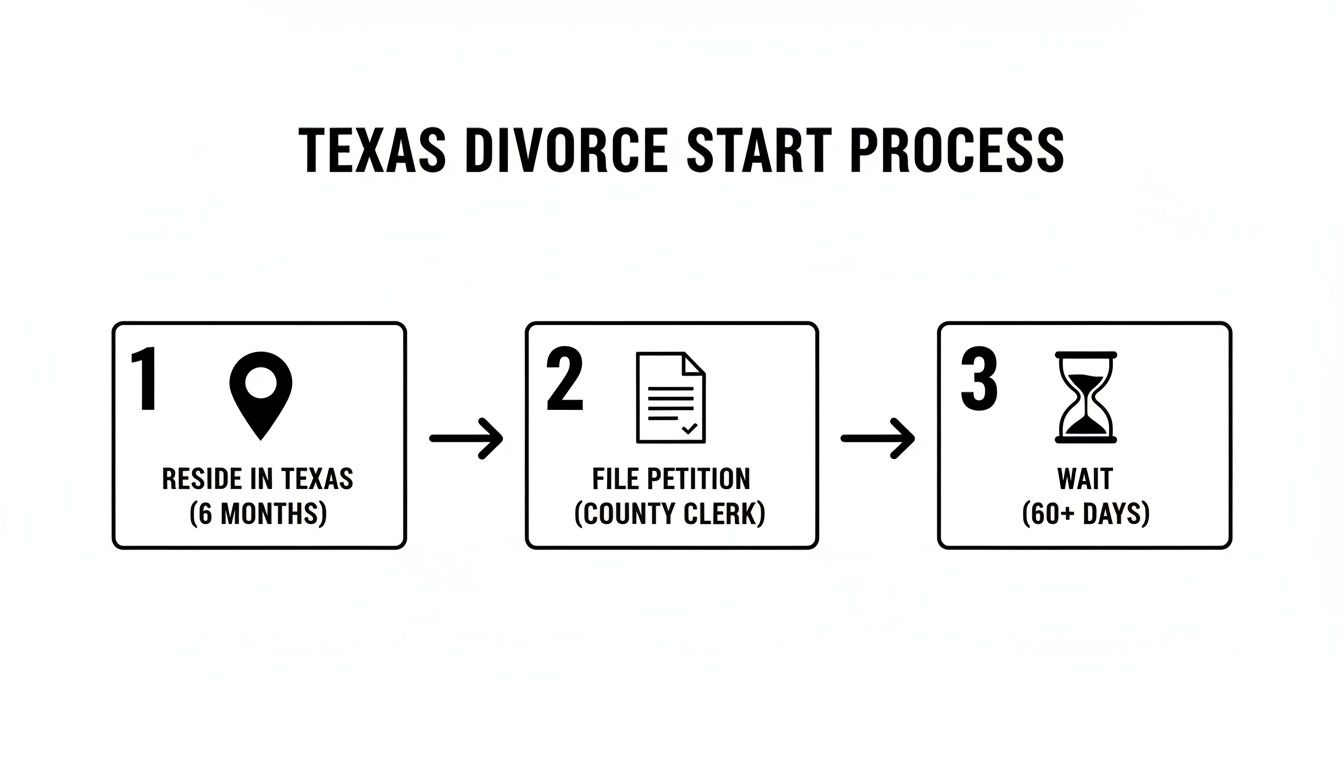
Seeing it visually helps simplify the start of the process. It's not one giant, overwhelming event but a series of clear, legally defined actions.
Understanding No-Fault Divorce in Texas
Texas is a "no-fault" divorce state, which is a relief for many couples. This means you do not have to prove that your spouse did something wrong to get divorced. The most common ground for divorce is insupportability.
Under Texas Family Code § 6.001, this simply means the marriage has broken down due to conflict or discord, and there’s no reasonable chance of reconciliation.
In plain English, you are telling the court that the marriage is broken beyond repair. The no-fault approach allows couples to end their marriage without airing private disputes in a public courtroom, which almost always reduces the conflict and emotional toll on everyone involved.
While fault-based grounds like adultery or cruelty still exist in Texas law, they are typically raised to influence how a judge divides property or makes custody decisions, not just to grant the divorce. For the vast majority of people, insupportability is the cleanest and most direct path forward.
If you’re contemplating this major life change, it’s vital to understand these initial steps. You might find our guide on taking your first step toward divorce helpful.
Before you file anything, it's wise to get organized. This checklist covers the basics you'll need to confirm before taking that first legal step.
Initial Texas Divorce Action Checklist
This table provides a quick reference for the essential first steps and legal requirements when you decide to initiate a divorce in Texas.
| Action Item | What It Means | Why It's Important |
|---|---|---|
| Confirm Residency | Verify that either you or your spouse has lived in Texas for at least 6 months and in a specific county for the last 90 days. | This is a non-negotiable legal requirement (Texas Family Code § 6.301). The court will dismiss your case if you don't meet it. |
| Gather Key Documents | Collect financial records, property deeds, birth certificates for children, and any prenuptial or postnuptial agreements. | This information is essential for filling out the petition accurately and preparing for property division. |
| Identify Grounds | Decide whether to file on "no-fault" grounds (insupportability) or if "fault" grounds (like adultery or cruelty) apply and are relevant. | This determines the core legal basis for your divorce and can influence property and custody outcomes. |
| Consult an Attorney | Speak with an experienced family law attorney to understand your rights, options, and the specific procedures for your county. | Getting expert advice early prevents costly mistakes and ensures you start the process on the right foot. |
Using this checklist helps ensure you’re not missing any foundational pieces before you officially begin the divorce process. A little preparation now saves a lot of headaches down the road.
Filing the Petition and Notifying Your Spouse
Once you’ve confirmed you meet the Texas residency requirements, the next step is drafting and filing the Original Petition for Divorce. This document officially kicks off your lawsuit and gets the entire process moving. You should think of it as the legal foundation for your whole case—getting it right from the beginning is absolutely critical to protecting your rights.

This petition is much more than a simple form; it’s a formal legal request to the court that lays out vital information. It tells the judge who you are, who your spouse is, details about your children, and the legal grounds for your divorce—which, as we’ve discussed, is usually “insupportability” in a no-fault Texas divorce. You can get a much deeper look into the specifics of what an Original Petition for Divorce includes in our detailed guide.
What Goes into the Divorce Petition
Beyond the basic identifying details, the petition is your first chance to make requests to the court. This is where you lay your cards on the table and ask for specific relief, which can cover a lot of ground:
- Temporary Orders: You can ask the judge for immediate orders to set temporary rules for things like who stays in the house, a temporary custody schedule for the kids, and who is responsible for paying certain bills while the divorce is pending.
- Property Division: The petition will formally state that you are seeking a “just and right” division of your community property.
- Conservatorship of Children: It will also address custody, asking the court to name conservators (parents who have legal rights) and establish a plan for possession, access, and child support.
Gathering all the necessary details—full legal names, dates of birth for everyone in the family, and dates of marriage and separation—is crucial to ensure the document is accurate from the start. Any mistakes here can cause frustrating and unnecessary delays down the road.
The Critical Step of Formal Notice or “Service”
After your petition is filed with the district clerk, the law requires you to formally notify your spouse that they are being sued for divorce. This legal notification is called service of process, and it’s a non-negotiable step that satisfies what’s known as “due process.” You can’t just text your spouse or hand them the papers yourself; it has to be done in a legally recognized way.
Properly serving your spouse is what gives the court jurisdiction over them, allowing it to make orders about your children and your property. Considering that about 50% of divorces in the U.S. involve children, Texas courts are especially focused on making sure both parents are properly brought into the case from the get-go.
There are two main ways to accomplish this in Texas:
1. Personal Service: This is the more formal route. A neutral third party—like a sheriff, constable, or certified private process server—personally delivers a copy of the filed petition and a legal notice called a “citation” to your spouse. That person then files a document with the court called a “Return of Service,” which is the official proof your spouse received the paperwork.
2. Waiver of Service: If your divorce is amicable, your spouse can agree to sign a Waiver of Service. This is a sworn document they sign in front of a notary, stating that they’ve received a copy of the petition and are voluntarily entering the lawsuit without the need for formal service. This method is often faster, cheaper, and sets a much more cooperative tone for the case.
Key Takeaway: The choice between personal service and a waiver really comes down to the relationship you have with your spouse. If communication is strained or you expect conflict, formal personal service is the safest bet. If you’re on good terms and both agree the divorce is necessary, a waiver can be a great way to streamline the beginning of the process.
Failing to properly serve your spouse will bring your case to a dead halt. The court simply cannot proceed, and a judge could dismiss your case entirely, forcing you to start—and pay for—the whole process all over again.
Securing Stability with Temporary Orders
Life doesn’t stop just because a divorce petition has been filed. The mortgage is still due, the kids have to get to school, and the light bill won’t wait. This immediate uncertainty is one of the most stressful parts of starting the divorce process. Who pays for what? Where will the children be sleeping next week?
This is exactly why Texas law provides a powerful tool to bring order to the chaos: Temporary Orders.

Think of Temporary Orders as a set of court-ordered ground rules you and your spouse must follow while the divorce is in progress. They are designed to provide stability and predictability, especially for your children, right from the very beginning. While they aren’t permanent, they establish a crucial status quo that protects everyone until a final agreement can be reached.
What Can Temporary Orders Accomplish?
When you file your Original Petition for Divorce, you can also ask the court for a hearing to get these orders in place. A judge can make decisions on a whole range of urgent issues, creating a clear framework for day-to-day life.
Here are some of the most common issues resolved in Temporary Orders:
- Exclusive Use of the Marital Home: The court can decide which spouse gets to live in the family house while the divorce is pending. This is often a huge concern for parents who want to keep things as stable as possible for their kids.
- Temporary Custody and Visitation: A temporary possession schedule is put on paper, spelling out exactly when each parent will have the children. This creates a consistent routine that serves the children’s best interests.
- Child and Spousal Support: A judge can order one spouse to pay temporary child support and, in certain situations, temporary spousal support to ensure financial needs are being met.
- Payment of Debts and Bills: The order can clarify who is responsible for paying the mortgage, car notes, credit cards, and other monthly expenses.
- Financial Restraining Orders: It’s standard practice for a judge to prohibit both parties from draining bank accounts, selling off property, or canceling insurance policies.
For a real-world example, we often represent clients where one spouse was the primary breadwinner while the other stayed home to raise the children. Temporary Orders can ensure the stay-at-home parent has the funds to pay the household bills and care for the children, preventing a sudden financial crisis. You can get a much clearer picture by reading our guide on what to expect in a Temporary Orders hearing.
It’s important to know that in Texas, you cannot finalize your divorce overnight. Under the Texas Family Code § 6.702, a judge cannot grant a final divorce decree until at least 60 days have passed since the initial petition was filed.
This “cooling-off” period serves two purposes. It gives couples a moment to potentially reconcile, but more practically, it provides a necessary window to sort out these temporary issues and start gathering financial information without the pressure of an immediate final deadline.
This 60-day window is the perfect time to get your Temporary Orders established. It gives you and your attorney time to prepare for the hearing, collect the necessary documents like pay stubs and bank statements, and build a solid case for the arrangements you are requesting.
Using this time wisely is a strategic move that sets the tone for the rest of your case. It’s not just a waiting game; it’s a preparation phase. By seeking Temporary Orders, you are taking a proactive step to protect your finances and your parental rights right from the start.
Uncovering the Facts Through Discovery and Mediation
You cannot build a fair and just divorce settlement on guesswork. You need facts. Once Temporary Orders are in place to create some stability, the next phase of your case is all about making sure you and your spouse have a complete, accurate picture of your shared financial life. This critical stage is called discovery.
Think of discovery as a formal, under-oath process for exchanging information. It’s designed to prevent surprises and ensure that when it comes time to divide your community estate, nothing is hidden or left out. While the term itself might sound intimidating, the goal is simple: create a level playing field where you can have honest negotiations.
Gathering Information with Legal Tools
The discovery process relies on specific legal tools to formally request information. These are legally binding requests, and the answers are provided under penalty of perjury. This is how we ensure the information is truthful and complete.
The most common tools we use for our clients include:
- Requests for Production: This is a formal demand for documents. For example, we might ask your spouse to produce the last three years of bank statements, credit card bills, mortgage documents, and retirement account statements.
- Interrogatories: These are written questions that your spouse must answer in writing, under oath. We could ask questions to identify every bank account they hold, clarify where certain income came from, or pinpoint when a specific asset was purchased.
Imagine a common scenario: one spouse handled all the family finances for years, leaving the other spouse with little knowledge about investment accounts or the true amount of debt. Through discovery, we can formally request those account statements and uncover the full financial picture, empowering our client to negotiate from a position of knowledge, not ignorance.
The Power of Mediation to Settle Your Case
With all the financial cards on the table, the next logical step for most Texas divorces is mediation. In fact, the vast majority of Texas judges will not even consider setting a case for a final trial until the couple has at least attempted mediation. There’s a very good reason for this: it works.
Mediation is a confidential meeting where you, your spouse, and your respective attorneys sit down with a neutral third-party mediator. The mediator’s job isn’t to make decisions for you. Instead, they facilitate a productive conversation, helping you find common ground and reach a settlement. You and your spouse retain all the decision-making power.
This process puts the control right back where it belongs—in your hands. Instead of letting a judge, who knows very little about your family, make life-altering decisions for you, mediation allows you to craft a customized agreement that actually works for your unique situation.
The statistics are compelling. An overwhelming majority of divorce cases—often cited as over 90%—settle out of court, and mediation is the primary reason why. It’s not just effective; it’s also far more cost-efficient and less emotionally draining than a drawn-out courtroom battle. As you prepare for this stage, knowing the real worth of your property is crucial. A great resource can help you learn how to determine fair market value to better inform your discussions.
Successful mediation often saves families 30-50% in legal costs compared to going to trial. The process empowers couples to move forward with agreements they created themselves, which almost always leads to better co-parenting relationships long after the divorce is final.
By embracing both discovery and mediation, you are taking proactive steps toward a fair outcome. This part of the process is less about confrontation and more about clarification, giving you the tools and the forum to resolve your case efficiently and with dignity.
Finalizing Your Divorce and Planning Your Next Chapter
After weeks or months of negotiations, meetings, and gathering documents, you are finally nearing the end of the divorce process. Everything you’ve worked through culminates in a single, crucial document: the Final Decree of Divorce. This isn’t just another piece of paper. It’s the legally binding blueprint for your new life, and every detail must be correct.

This decree solidifies every agreement you and your spouse have made, leaving no room for interpretation. It’s the final word on everything from who gets the house to the specifics of your parenting plan.
What Is in a Final Decree of Divorce?
This is a comprehensive document that must cover every single aspect of your marriage’s dissolution. A well-drafted decree is painstakingly specific, which is your best defense against future arguments and confusion.
Here’s what a Texas Final Decree must include:
- Property Division: It lists every significant asset—the house, cars, bank accounts, retirement funds—and explicitly states who is awarded what. We use account numbers and vehicle VINs to be crystal clear.
- Debt Allocation: Just like with assets, every debt—the mortgage, credit card balances, car loans—is assigned to one person for repayment.
- Child Custody Orders: The decree will contain the complete custody arrangement, what Texas calls a Possession Order. This details the rights, duties, and possession schedule for each parent with calendar-like precision.
- Child and Medical Support: It spells out the exact monthly child support amount, how medical and dental expenses will be handled, and precisely when payments are due.
For instance, if you have a piece of furniture with sentimental value, your decree can state, “Wife is awarded the antique oak dining table located at the marital residence.” That level of detail is exactly what prevents future headaches.
The Final Court Appearance or “Prove-Up” Hearing
Once the Final Decree of Divorce is drafted and signed by you, your spouse, and both of your attorneys, it must be presented to a judge. In an uncontested divorce, this is usually done at a short, informal hearing called a “prove-up.”
Typically, only one spouse and their attorney need to be present. You will take the witness stand and answer a handful of simple, scripted questions to confirm your identity, that you meet the residency requirements, and that the agreements laid out in the decree are fair. The judge then signs the decree, and at that moment, it becomes an official, enforceable court order. Your divorce is legally final.
Life After the Decree: Planning Your New Beginning
Finalizing the legal process is a massive relief, but it’s also the starting line for your next chapter. You’ll have several practical and administrative tasks to tackle to secure your new, independent life.
This is a time to look forward and ensure your legal and financial foundations are updated to reflect your new reality. Taking these steps provides security and peace of mind as you move forward.
As you finalize your divorce and plan your next chapter, it’s crucial to also focus on your emotional recovery. Taking the time to process the transition is just as important as handling the legal paperwork, and resources like this guide on How to Heal After Divorce can offer valuable support.
Here are some essential post-divorce actions:
- Updating Your Estate Plan: Your old will almost certainly names your ex-spouse as a beneficiary or executor. It’s critical to create a new will, powers of attorney, and other estate planning documents immediately.
- Changing Beneficiary Designations: Don’t forget to update the beneficiaries on your life insurance policies, retirement accounts (like 401(k)s and IRAs), and bank accounts.
- Enforcing the Decree: If your ex-spouse fails to follow the court’s orders—for example, they don’t pay child support or refuse to sign over a car title—you have the right to file an enforcement action to compel them to comply.
How to Prepare for Your Consultation with Our Firm
Taking the step to schedule a consultation with a family law attorney is a significant, proactive move toward gaining control and finding clarity during a confusing time. That first meeting can feel intimidating, but showing up prepared can turn it from a simple conversation into a powerful strategy session.
Our main goal for your free consultation is to give you specific, meaningful advice you can actually use. A little prep work on your end helps us do exactly that.
Think of this meeting less like a formal interview and more like the first step in a partnership. To make the most of our time together, we suggest gathering a few key items. This groundwork lets us skip the generalities and dive right into the unique details of your situation from the moment you sit down with us.
What to Bring With You
The more information we have from the start, the more specific our guidance can be. Don’t worry if you can’t find every single document, but this list is an excellent starting point:
- Financial Documents: If possible, bring your most recent tax return along with recent pay stubs for both you and your spouse. This gives us a quick, clear snapshot of your family’s financial picture.
- Asset and Debt List: Sketch out a simple list of what you own and what you owe. Think about your house, cars, bank accounts, retirement funds, mortgages, and any credit card balances. Ballpark numbers are perfectly fine for this first meeting.
- A Brief Timeline: Jot down a handful of important dates. We’ll want to know when you were married, when you separated (if that’s already happened), and the birthdates of your children.
Most importantly, come ready with your questions. Before you come to our office, take a few minutes to write down your biggest worries and what you hope to achieve. What is keeping you up at night? What does a good outcome look like to you?
Your questions are what steer our conversation. Whether you’re worried about staying in the family home or protecting your time with your children, your priorities immediately become our priorities. No question is too small or insignificant.
Being prepared isn’t about you having all the answers—that’s our job. It’s about giving us the tools we need to provide the best possible advice as you figure out the path forward.
Common Questions About Starting a Divorce in Texas
When you’re first considering divorce, it feels like you have a million questions and no clear answers. That’s completely normal. The road ahead seems complicated, but getting answers to the big questions can bring a lot of clarity. Here are straightforward, practical answers to the concerns we hear most often from people just starting to navigate this process.
How Much Does It Cost to Start a Divorce in Texas?
This is often the first question on everyone’s mind. The truth is, the total cost can vary widely depending on your specific situation. Getting the process started involves a court filing fee, which is typically a few hundred dollars. After that, the real cost driver is whether your divorce is contested or uncontested.
An uncontested divorce, where you and your spouse have already agreed on everything, is always the most affordable path. If you disagree on major issues like property division or custody, it becomes a contested divorce. These disagreements require more time for negotiations, legal strategy, and potentially court appearances, which will increase the cost. The best way to get a realistic estimate is to discuss the specifics of your case with an attorney.
Do I Have to Move Out of My House When I File?
Absolutely not. There is no law in Texas that forces you to leave the marital home just because a divorce has been filed. In fact, if you have children, moving out prematurely can sometimes complicate your custody case later on.
So, who stays and who goes? This is usually decided in one of two ways: either you and your spouse reach an agreement, or a judge decides for you at a temporary orders hearing. In a hearing, the judge will consider what’s in the best interest of the children and each spouse’s financial situation before making a ruling.
What Is the Difference Between Contested and Uncontested?
This is a simple distinction, but it makes all the difference in how your case proceeds.
- An uncontested divorce means you and your spouse are in 100% agreement on every single issue. This includes the division of all property and debts, child custody, visitation schedules, and any support payments. When it’s uncontested, our job is primarily to draft the legal paperwork correctly to make your agreement binding.
- A contested divorce means you disagree on at least one thing. It could be something small, or it could be everything. These are the cases that require more intensive negotiation, mediation, and sometimes, a trial to resolve the issues.
It’s important to remember that most divorces that begin as contested do not end up in a full-blown trial. The majority are settled through negotiation or mediation.
Can I Get a Divorce If I Cannot Find My Spouse?
Yes, you can. It’s more complicated, but it is possible to divorce a spouse whose whereabouts are unknown. The legal process for this is called “service by posting” or “service by publication.”
This involves a special procedure to provide legal notice in a way the court approves, such as posting a notice at the courthouse. If your spouse does not appear or respond after this public notice is given, the court can move forward with the divorce and grant a default judgment.
If you need help navigating divorce, custody, or estate planning in Texas, contact The Law Office of Bryan Fagan, PLLC today for a free consultation at https://bryanfagan.com.