
It usually starts late at night, when the house is finally quiet and the questions get louder. What happens next? How long will this take? And am I about to make a mistake that I can’t undo? For many Texas parents, the decision to divorce isn’t impulsive—it’s careful, emotional, and heavy with responsibility. When people search How to File Divorce Online Texas, they’re often not looking for shortcuts. They’re looking for reassurance that there’s a way forward that won’t create more chaos than the marriage already has.
At The Law Office of Bryan Fagan, PLLC, we understand that filing a divorce online feels appealing because it offers a sense of control during a moment when so much feels uncertain. But Texas divorce law is not a checklist you can rush through without consequences. Under Texas Family Code §153.002, courts are required to focus on the best interest of the child, and judges evaluate far more than whether forms are filled out correctly. They look at stability, decision-making, consistency, and whether parents truly understand the long-term impact of the agreements they submit—even in uncontested, online-filed cases.
Our firm is led by Bryan Joseph Fagan, a South Texas College of Law graduate and a recognized authority on Texas divorce and custody law, and for years we’ve guided Houston-area families through this exact crossroads. We’ve seen parents come in confident they “did everything online,” only to realize later that unclear language, missed legal requirements, or rushed decisions created problems that followed them for years. We’ve also seen the opposite—families who used online filing wisely, with the right guidance, and found peace on the other side much sooner.
This article is here to give you clarity before you click “submit.” You’ll learn what filing divorce online in Texas really means, where the risks are hiding, and how thoughtful legal planning can protect your future while honoring the reason most parents start this journey in the first place—to reclaim peace of mind and move forward with confidence.
Key Takeaways
- Texas allows electronic filing of divorce documents through eFileTexas.gov, but the underlying divorce process still requires full compliance with Texas Family Code requirements, court oversight, and judicial approval
- Online filing works best for uncontested divorce cases where both spouses agree on all issues including property division, child custody arrangements, and child support
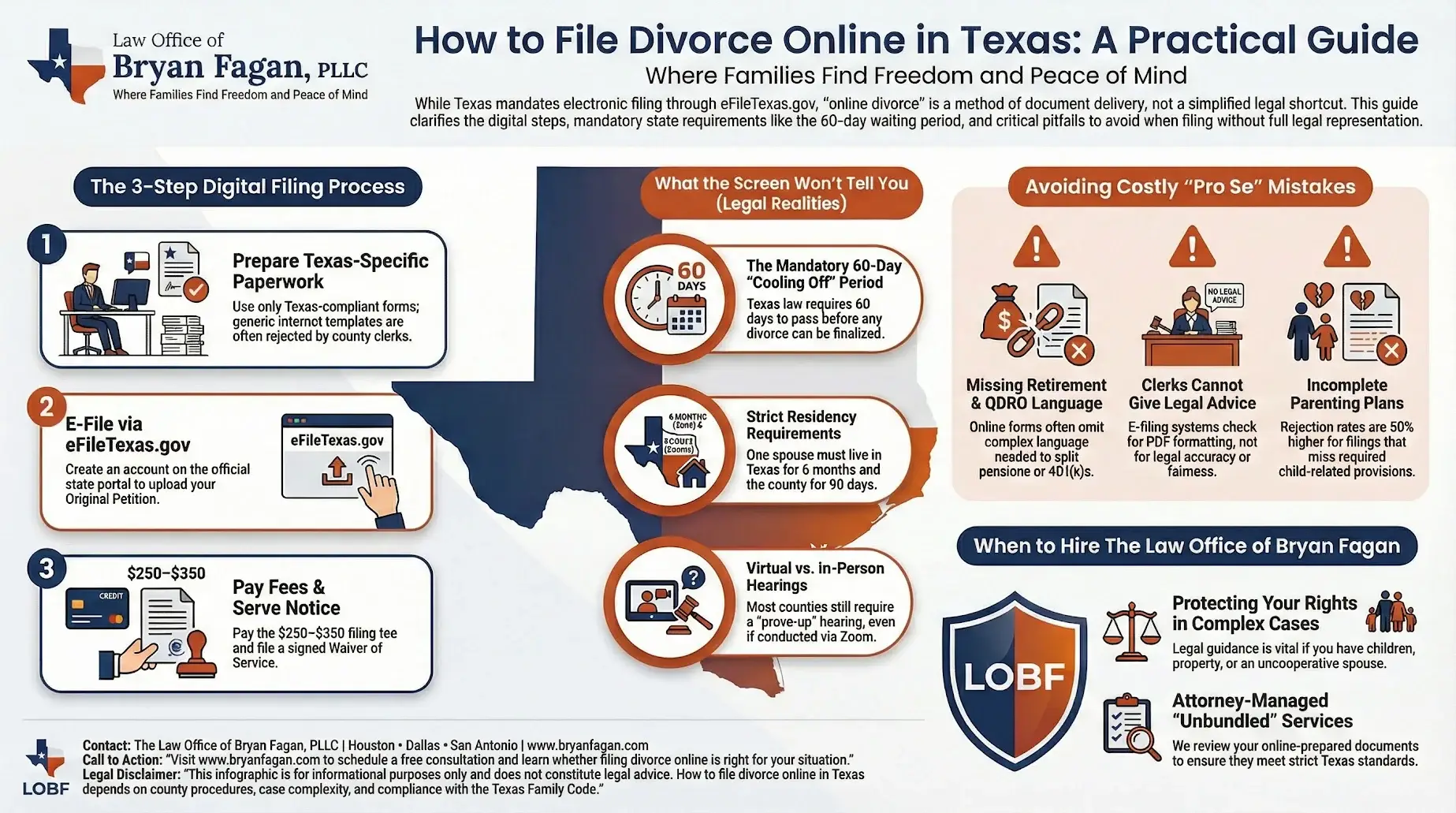
- You must meet Texas residency requirements—at least one spouse must have lived in Texas for six months and in the filing county for 90 days—and complete the mandatory 60 day waiting period regardless of how you file
- While divorce papers can be filed electronically, service of process and court hearings typically still require traditional procedures or attorney assistance
- Professional attorney review of online-prepared documents helps prevent costly mistakes, rejected filings, and unenforceable divorce decrees

Your Family’s Future Starts Here
Don’t navigate your legal journey alone. Schedule a consultation now and get the clarity and support you deserve.
What “How to File Divorce Online Texas” Really Means
Under Texas law, How to File Divorce Online Texas means submitting required divorce documents electronically through the state’s official court filing system, not using an automated shortcut that avoids judicial oversight. This distinction is critical for families seeking efficiency without compromising legal protection. While electronic filing modernizes how paperwork reaches the courthouse, Texas courts continue to apply the same substantive requirements found in the Texas Family Code, including residency standards under §6.301 and full compliance with statutory pleading rules before a case can proceed.
Electronic filing became mandatory for most Texas family law cases following updates to the Texas Rules of Civil Procedure, including Rule 21(f), and it has dramatically reduced the need for in-person courthouse visits. Parties can upload PDF pleadings, pay filing fees securely, and receive file-stamped confirmations with a cause number—often within hours. This convenience reflects a broader shift in Texas law toward accessibility through technology, a trend also seen in estate planning innovations like electronic wills, which are discussed in Evolving With the Times: Electronic Wills. These changes show how Texas embraces modernization while preserving judicial safeguards.
Just as important is what electronic filing does not do. It does not prepare your divorce paperwork, provide legal advice, complete service of process, or remove the requirement that a judge review and sign the Final Decree of Divorce. The Texas Family Code continues to govern every aspect of the case, including the mandatory waiting period under §6.702, community property division under §7.001, and, when children are involved, custody and support decisions guided by the best interest of the child standard in §153.002. Courts expect online-filed cases to meet the same legal standards as traditionally filed cases, and missing or unclear provisions can still result in delays or long-term enforcement problems.
For families navigating divorce, understanding the difference between convenience and compliance is empowering. Online filing changes how documents are delivered to the court—not what those documents must legally accomplish or how a case is evaluated. For additional guidance on navigating the process with clarity and confidence, resources like this Texas Divorce Process Overview from the team at Bryan Fagan’s firm can help families move forward while protecting their futures.

Who Can File for Divorce Online in Texas
Any Texas resident who satisfies the statutory requirements may use electronic filing, and understanding How to File Divorce Online Texas begins with knowing who qualifies and when online filing makes sense. Texas Family Code §6.301 requires that at least one spouse have lived in Texas for the preceding six months and in the county of filing for at least 90 days. These residency rules are firm and apply regardless of whether documents are submitted electronically or in person, meaning online filing cannot shorten or bypass jurisdictional requirements.
Self-represented, or pro se, filing is permitted in Texas, and many individuals choose this option through the state’s electronic filing system. You are not required to hire an attorney to submit divorce paperwork online, and the platform provides tools to upload pleadings and manage filings efficiently. However, the Texas Family Code still governs every substantive aspect of the case, including the mandatory waiting period under §6.702 and the division of marital property under §7.001. Filing electronically changes the method of submission, not the legal standards your case must meet.
Online filing is most effective for uncontested divorces, where both spouses have already agreed on property division, debt allocation, and—when applicable—child custody and child support. When disputes are resolved in advance, cases often move more smoothly, and the likelihood of court delays is reduced. Even so, Texas courts continue to review agreements closely, especially those involving children, to ensure compliance with the best interest of the child standard set out in §153.002. For a deeper discussion of when online filing is helpful and when it may create risk, families often benefit from reviewing the pros and cons of filing for divorce online in Texas as part of their decision-making process.
Certain situations require additional care, even when online filing is available. Military families may be affected by federal protections such as the Servicemembers Civil Relief Act, which can alter timelines and procedural requirements. When a spouse lives out of state, service of process and jurisdictional issues become more complex, sometimes requiring strategic planning to avoid delays or invalid filings. In these circumstances, guidance from an experienced Texas family law team—such as the attorneys who regularly publish educational resources like this Texas Divorce Process Overview—can help families move forward with confidence while protecting their long-term interests.

Step-by-Step: How to File Divorce Online Texas
Let me walk you through exactly how to file divorce online Texas from start to finish. This process assumes you’re pursuing an agreed divorce where both spouses are cooperating.
Step 1: Prepare Texas-Compliant Divorce Paperwork
You’ll need the Original Petition for Divorce as your primary filing document. Texas-specific forms are available through TexasLawHelp.org or through the guided interview on eFileTexas.gov. Do not use generic divorce forms from other states—Texas courts reject them, and this is one of the most common mistakes I see.
Your divorce petition must include your grounds for divorce (typically insupportability, which is Texas’s no-fault option), the relief you’re requesting, and required disclosures. If you have children, you’ll need additional forms including a parenting plan.
Step 2: Create Your eFileTexas.gov Account
Registration is free. You’ll create a username and password, then verify your identity. The system walks you through selecting the correct county and court type.
Step 3: File the Original Petition for Divorce
Upload your completed petition as a PDF (the system has specific format and file size requirements). Select your county’s district clerk’s office as the filing destination. Submit the filing and you’ll receive electronic confirmation with your cause number.
Step 4: Pay Filing Fees Online
Court costs for filing a Texas divorce range from $250 to $350 depending on your county—urban counties like Harris and Dallas tend to be on the higher end. Payment is made by credit card through the e filing system. If you qualify based on income, you can file a Statement of Inability to Afford Payment of Court Costs to request a fee waiver.
Step 5: Serve Your Spouse or Obtain a Waiver of Service
Your spouse must be legally notified of the divorce filing. In an agreed divorce, the simplest approach is a Waiver of Service under Texas Rules of Civil Procedure Rule 119—your spouse signs a form acknowledging they received the divorce petition and waive formal service. This waiver can be filed electronically.
If your spouse won’t sign a waiver, you’ll need to arrange formal service through a process server, constable, or certified mail. This step cannot be skipped; improper service can invalidate your entire proceeding.
Step 6: Complete the 60 Day Waiting Period
Texas Family Code §6.702 mandates a 60-day waiting period from the date you file your original petition before your divorce can be finalized. This waiting period cannot be waived except in cases involving family violence under Texas Family Code §6.702(b). Plan your timeline accordingly.
Step 7: File Additional Documents
Before finalization, you’ll need to submit additional documents including financial disclosures, your proposed Final Decree of Divorce (signed by both parties in an agreed divorce), and if children are involved, your parenting plan and child support order. The Texas Vital Statistics Unit requires form VS-165 for divorce records—some counties allow electronic submission.
Step 8: Finalize Your Divorce
In many fully agreed uncontested cases, courts can finalize the divorce without a final hearing. Other cases require a brief prove-up hearing where the judge verifies that everything is in order. You’ll receive electronic notice of finalization through the eFileTexas system.
What Parts of a Texas Divorce Can Be Done Online
When families are learning How to File Divorce Online Texas, it helps to understand just how much of the process can now be managed electronically and where the system adds real value. Texas courts allow parties to file nearly all pleadings and motions online, including the Original Petition for Divorce, responses, and agreed orders, while paying court costs securely through electronic payment systems. These filings are still governed by the Texas Family Code, including jurisdictional requirements under §6.301 and procedural timelines such as the mandatory waiting period in §6.702, but the method of submission has become far more efficient and accessible for Texas families.
Electronic filing also allows parties to receive court notices in real time, including hearing dates, deficiency notices, and updates on case status. Final decrees and supporting documents can be submitted electronically for judicial review, and judges must still evaluate those documents under applicable statutes such as §7.001 for community property division and §153.002 when child-related issues are involved. The ability to track filings and court responses through a centralized system has significantly reduced uncertainty and delays compared to the old paper-based process, giving families clearer insight into where their case stands at any given moment.
With this convenience, however, comes an increased responsibility to protect personal and financial information. Electronic divorce filings often contain sensitive data, and Texas law places clear expectations on how that information is handled and disclosed. Families navigating online filing frequently benefit from understanding digital privacy considerations, which are discussed in Electronic Privacy Laws and Texas Divorce. Awareness of these issues can help prevent unintended disclosures while ensuring compliance with court rules and statutory requirements.
For those seeking additional guidance on how electronic filing fits into the broader divorce process, resources like this Texas Divorce Process Overview offer helpful context. By combining modern filing tools with a clear understanding of Texas law and privacy protections, families can move through divorce with greater confidence, clarity, and peace of mind—goals that remain central to the work of Bryan Fagan’s family law team.
What Cannot Be Done Online in a Texas Divorce
While electronic filing offers convenience, understanding How to File Divorce Online Texas also means recognizing its limits and knowing when additional legal support is essential. Texas courts are clear that electronic filing is a method of submitting documents, not a substitute for legal guidance or judicial oversight. Judges must still apply the Texas Family Code in full, including the best interest of the child standard under §153.002 and the statutory requirements governing property division and support. Online tools cannot advise you on whether your proposed outcome is fair, enforceable, or aligned with what a Texas court is likely to approve.
One of the most common misunderstandings families encounter is assuming the court or the e-filing system will guide them if something is missing or unclear. Courts are prohibited from giving legal advice, and clerks only review filings for procedural compliance, not legal accuracy. If you and your spouse disagree about custody, visitation, child support under Texas Family Code Chapter 154, or the division of marital property, those disputes must be resolved through negotiation, mediation, or formal court proceedings. No online platform can replace hearings that involve evidence, testimony, and judicial discretion, particularly when children or substantial assets are involved.
Complex financial situations also demand careful drafting that online form generators often cannot handle properly. Retirement accounts frequently require Qualified Domestic Relations Orders authorized through Texas Family Code §7.001, real estate must be described with precise legal language, and business interests often need valuation before they can be divided. Errors in these areas may not surface immediately, but they can create serious enforcement problems years later. Families weighing whether online filing fits their circumstances often benefit from reviewing Is Filing for Divorce Online in Texas the Best Option for You? to better understand where convenience ends and legal risk begins.
Finally, even in uncontested cases, some level of court involvement is unavoidable. Judges must review and sign the Final Decree of Divorce, and many counties still require a brief prove-up hearing, whether conducted in person or by video. While Texas courts have expanded virtual hearing options in recent years, hearings themselves cannot be eliminated. For families seeking clarity on these procedural realities and how they intersect with long-term stability, resources like this Texas Child Support Overview from the attorneys at Bryan Fagan’s firm can provide valuable context and reassurance as you move forward.

Filing Divorce Online Texas With Children
When minor children are involved, understanding How to File Divorce Online Texas becomes far more nuanced, and the risks of relying on online-only solutions increase significantly. Texas courts treat child-related issues with heightened scrutiny, and electronic filing does not reduce the legal standards that must be met. Parenting decisions, support obligations, and communication rights are all governed by the Texas Family Code, and judges carefully review these provisions to ensure children are protected during and after the divorce process.
Texas law requires a detailed parenting plan that addresses conservatorship, possession and access schedules, and, when applicable, geographic restrictions on where a child may live. The Standard Possession Order set out in Texas Family Code §§153.3101–153.317 provides a default framework, but courts expect parents to tailor these terms to their family’s specific needs. This includes practical considerations such as school schedules, transportation, and communication between the child and each parent, which are often overlooked in generic online templates. Parents frequently benefit from reviewing resources like child custody and phone calls in Texas divorce to better understand how detailed these provisions should be.
Child support is another area where precision matters. Texas Family Code Chapter 154 sets clear guidelines, starting at 20% of the paying parent’s net resources for one child and increasing up to 40% for five or more children. Final decrees must also include legally compliant provisions for health insurance and medical support. Even small drafting errors can lead to enforcement problems later, which is why courts do not relax these requirements simply because a case is filed online. For additional context on support obligations, families often turn to educational materials like this Texas Child Support Overview published by Bryan Fagan’s family law team.
Above all, Texas courts apply the “best interest of the child” standard under Texas Family Code §153.002 when evaluating custody and parenting plans. Even in fully agreed divorces, judges frequently require a prove-up hearing to confirm that the proposed arrangement truly serves a child’s welfare. When key issues are missing—such as geographic restrictions, communication rights, or retroactive child support—cases can be delayed for months, and poorly drafted orders can create disputes that last for years. For parents, combining the convenience of electronic filing with informed legal guidance can make the difference between a smooth transition and ongoing conflict, reinforcing the firm’s commitment to educating families and protecting futures.
Common Mistakes When Filing Divorce Online Texas
After years of helping clients, I’ve seen the same mistakes derail online divorce filings repeatedly. Here’s what to avoid:
Using generic, non-Texas forms. Each county may have specific requirements, and Texas law has provisions that generic online templates miss entirely. A 2025 filing in Travis County was rejected twice because the petitioner used California forms—costing an additional $200 in fees and a four-month delay.
Improper service of process. Service must be completed correctly, or your divorce is legally defective. An invalid Waiver of Service—signed by the wrong person, not properly notarized, or filed incorrectly—can invalidate your entire case.
Missing mandatory provisions. Final decrees must address retirement accounts, debts, and all community property. Failing to include a QDRO for pension division, for example, can leave you fighting over assets years later.
Incomplete child-related provisions. Omitting health insurance requirements, failing to specify possession schedules clearly, or not addressing passports and travel can create ongoing legal problems.
Assuming courts will fix errors. Texas courts don’t review your documents for mistakes before you file them. Clerks check for procedural compliance, not legal accuracy. If your decree is missing required elements, it may be signed—and then be unenforceable later.
Data suggests pro se divorces have 40% higher amendment rates than attorney-filed cases. Those amendments cost time and money.
Online Divorce Services in Texas: Pros and Cons
Many families exploring How to File Divorce Online Texas encounter commercial online divorce services that advertise fast results for a few hundred dollars. These platforms are best understood as document preparation tools, not sources of legal representation, and recognizing that distinction is essential for anyone trying to protect their future. While these services can feel accessible and budget-friendly, Texas law still requires strict compliance with the Texas Family Code, and courts do not relax those standards simply because paperwork was generated online.
Most online divorce services rely on questionnaire-based form completion to generate template documents and, in some cases, offer assistance with electronic filing. What they do not provide is equally important. They cannot offer legal advice about your specific circumstances, customize documents for complex property or custody issues, represent you at hearings, or guarantee that filings comply with Texas law. Judges reviewing divorce cases must still apply statutes such as Texas Family Code §7.001 governing community property division and §153.002 requiring that all child-related decisions serve the best interest of the child, regardless of how the paperwork was created.
The appeal of these services is understandable. They are significantly less expensive than full attorney representation and can generate documents quickly. However, the risks are real and often underestimated. Industry data and courtroom experience show that a substantial number of online-prepared divorces later require attorney corrections, sometimes costing more than hiring legal guidance would have initially. Generic templates may overlook Texas-specific requirements for child support calculations under Texas Family Code Chapter 154, retirement divisions that require Qualified Domestic Relations Orders, or standing orders that automatically apply in counties such as Harris. Families weighing these tradeoffs often find clarity by reviewing the benefits and drawbacks of filing for divorce online in Texas as part of an informed decision-making process.
For truly straightforward, uncontested divorces involving no children and minimal assets, online services may be adequate. As soon as a case involves children, real estate, retirement accounts, or disagreement between spouses, the margin for error narrows significantly. Guidance from an experienced Texas family law team—such as the attorneys who regularly publish educational resources like this Texas Divorce Process Overview—can help families balance convenience with compliance, ensuring that short-term savings do not turn into long-term legal problems.

How a Texas Divorce Attorney Helps With Online Divorce Filing
You don’t have to choose between doing everything yourself and paying for full legal representation. Many Texas family law attorneys, including our firm, offer limited-scope or unbundled services designed specifically for people who want to file online but need professional oversight.
Document review services allow an attorney to review your completed forms before filing, checking for Texas Family Code compliance and common errors. This typically costs $500-1,500—far less than full representation but providing significant protection.
Strategic drafting ensures your final decree contains enforceable provisions. Precise language matters enormously for issues like retirement divisions, real property transfers, and custody arrangements.
Attorney assistance reduces rejection rates by an estimated 80% and significantly decreases the likelihood of post-divorce litigation. When your decree is drafted correctly the first time, you avoid the 30% of pro se cases that face enforcement problems later.
Flat-fee options provide cost certainty. You know exactly what you’ll pay for document preparation, review, and filing assistance.
Why Choose The Law Office of Bryan Fagan, PLLC for Online Divorce Guidance
The team behind The Law Office of Bryan Fagan has fully embraced modern tools like electronic filing while never losing sight of the legal precision Texas families depend on. Our attorneys work with these systems every day across courts throughout the state, which gives us a practical, ground-level understanding of How to File Divorce Online Texas in a way that complies with the Texas Family Code and protects our clients’ long-term interests. Convenience matters, but so does getting it right the first time, especially when judges must still apply statutes such as §6.702 for waiting periods, §7.001 for community property division, and §153.002 when children are involved.
One of the reasons families turn to our firm is flexibility. Some clients want full-service representation, while others prefer limited-scope assistance such as document review or strategic guidance on specific issues. We tailor our approach to fit each situation and budget, helping clients weigh options thoughtfully rather than pushing a one-size-fits-all solution. For those exploring whether online filing truly fits their circumstances, we often point them to resources like the benefits and drawbacks of filing for divorce online in Texas to support informed decision-making.
Precision in drafting is another hallmark of our work. Over the years, our attorneys have helped many families who initially filed online only to discover later that their decrees were missing enforceable child support language under Texas Family Code Chapter 154, contained vague custody provisions, or failed to address retirement assets properly. These issues rarely surface immediately, but they can create costly disputes down the road. By focusing on clear, statute-compliant drafting from the outset, we help clients avoid problems that linger long after a case is finalized.
Just as important is communication. Divorce is stressful enough without uncertainty about what comes next, and our legal team prioritizes keeping clients informed and supported at every stage of the process. From the first filing through the judge’s final signature, our goal is to provide clarity, reassurance, and practical guidance. Ultimately, the attorneys at Bryan Fagan’s firm care about more than completing a filing—they focus on protecting futures, reducing long-term conflict, and helping families move forward with confidence and peace of mind.

Actionable Checklist: How to File Divorce Online Texas
Before you begin the online filing process, confirm each of these items:
- [ ] Residency verified: At least one spouse has lived in Texas for 6 months and in your filing county for 90 days
- [ ] Divorce is uncontested: You and your spouse agree on all issues or are willing to negotiate to agreement
- [ ] Texas-specific forms obtained: Using forms from TexasLawHelp.org or eFileTexas, not generic templates
- [ ] All assets and debts identified: Including retirement accounts, real property, vehicles, and credit card balances
- [ ] Child-related issues resolved (if applicable): Custody, possession schedule, and child support agreed upon
- [ ] Service plan determined: Waiver of Service prepared or formal service arranged
- [ ] Documents reviewed for completeness: All required provisions included in your final decree
- [ ] Attorney consultation scheduled: Professional review before final submission protects your interests
Conclusion
Divorce is rarely about paperwork alone. It’s about closing one chapter of life while trying to protect the people and priorities that matter most as you open the next one. Filing online can be a helpful tool, but it works best when it’s paired with understanding, intention, and a clear view of the road ahead. When parents take the time to approach the process thoughtfully, the outcome is often not just a finalized case—but a sense of stability and relief that makes moving forward feel possible again.
If you’re considering how to file divorce online in Texas, give yourself permission to slow down just enough to make sure the decisions you’re making today won’t create unnecessary stress tomorrow. A well-prepared divorce can reduce conflict, prevent costly fixes later, and help your family transition with more confidence and less uncertainty. Sometimes that means asking questions, double-checking assumptions, or getting guidance from someone who has seen how these cases play out in real life.
Working with an experienced Texas family law attorney doesn’t have to mean turning the process upside down or losing control of it. Often, it means gaining clarity, avoiding hidden pitfalls, and knowing that someone is watching out for your long-term interests. At The Law Office of Bryan Fagan, PLLC, we believe families deserve education, compassion, and practical solutions—especially when life feels complicated.
If you’re ready to take the next step or just want to talk through your options, we’re here to help. And if nothing else, remember this: doing it “online” doesn’t mean doing it alone, and the right support can make all the difference.
Frequently Asked Questions About Filing Divorce Online in Texas
Yes, many parts of a Texas divorce can be handled online. Texas allows electronic filing of divorce documents through its official e-filing system, which means you can submit paperwork and pay court fees electronically. However, filing online does not bypass legal requirements. You must still meet residency rules, properly serve your spouse (or obtain a waiver), comply with waiting periods in most cases, and obtain a judge’s signature for the divorce to be final.
The cost to file for divorce online in Texas depends on the county, but filing fees are typically a few hundred dollars. Even when filing electronically, the court cost itself does not change. Some e-filing platforms may charge a small processing or convenience fee. If you cannot afford the filing fee, Texas law allows you to request a fee waiver by submitting a Statement of Inability to Afford Payment of Court Costs for the judge to review.
You can file for divorce on your own, also known as filing “pro se,” by preparing Texas-specific divorce forms, filing an Original Petition for Divorce in the proper county, and completing legal service on your spouse or obtaining a valid Waiver of Service. After meeting the waiting period in most cases, you must submit a Final Decree of Divorce for the court’s approval. Many self-filed cases run into problems due to missing language, improper service, or unclear agreements, which is why attorney review can be helpful even if you handle most of the process yourself.
Filing online does not shorten Texas’s required timelines. In most cases, Texas law requires a waiting period before a divorce can be finalized. Uncontested cases with proper paperwork and service tend to move faster, while contested cases or cases with filing errors take longer. County court schedules and whether a brief prove-up hearing is required also affect timing.
Yes, electronic filing is legitimate and widely used in Texas courts. The key distinction is that “online divorce” usually refers to how documents are submitted, not how the divorce is legally handled. Courts do not review documents for fairness or completeness before accepting them. Commercial online divorce services may help generate forms, but they do not provide legal advice, which is why many people choose to have a Texas family law attorney review documents before filing.
In most Texas divorces, an immediate divorce is not possible because state law generally requires a waiting period before finalization. There are limited exceptions in certain situations, such as specific cases involving family violence, but those cases often require court hearings and careful legal handling. For most people, the fastest realistic option is an uncontested divorce with accurate paperwork and proper service to avoid delays.
Typically, the quickest and least expensive option is an uncontested divorce where both spouses agree on all major issues, including property division and, if applicable, child custody and support. Filing online can save time and reduce logistical hassle, but court costs still apply. Many families control costs by combining online filing with limited-scope legal help, such as attorney review of the Final Decree, to avoid costly mistakes later.
The cheapest approach is usually a straightforward, uncontested divorce with no disputes and simple assets, filed using Texas-compliant forms. Some people qualify for court fee waivers, which can significantly reduce costs. However, the least expensive option upfront is not always the least expensive long-term. Errors or vague language in a divorce decree can lead to enforcement problems or modification cases that cost far more later.
It depends on the county and the judge. Some uncontested divorces can be finalized without an in-person appearance, while others require a short prove-up hearing where the judge confirms the agreement and ensures it complies with Texas law. Even when no hearing is required, a judge must still review and sign the Final Decree of Divorce for it to become legally effective.