
Divorce can be one of life’s most difficult transitions—but understanding your rights under Texas law can make it less overwhelming. When you’re facing a divorce, the thought of a drawn-out, public court battle can be paralyzing. But that’s not your only option. In Texas, there’s a much more constructive path forward: divorce mediation. This is a confidential and collaborative process where you and your spouse sit down with a neutral professional to make your own decisions about your future, far away from a courtroom.
A Path to Peaceful Resolutions
Divorce is easily one of life’s most challenging transitions, but knowing your options under Texas law can make the journey feel much less daunting. Mediation provides a structured, yet comfortable, setting where you and your spouse can openly discuss and resolve the big issues with the help of a trained, impartial third party—the mediator.
It helps to think of a mediator not as a judge who hands down rulings, but as a skilled facilitator. Their job isn’t to take sides or force decisions. Instead, they guide the conversation, help manage the inevitable points of conflict, and work to find common ground on the things that matter most to your family.
Empowering You to Control the Outcome
The real power of Texas divorce mediation is that it puts you and your spouse in the driver’s seat. You get to create a customized settlement agreement that actually works for your unique family situation. This keeps the decision-making authority firmly in your hands, rather than turning it over to a judge who only knows the surface-level facts of your life.
Key issues that are typically hammered out in mediation include:
- Property Division: Figuring out how to divide the assets and debts you’ve accumulated during your marriage in a way that both of you see as fair.
- Child Custody and Visitation: Crafting a detailed parenting plan that puts your children’s well-being and stability first.
- Child Support and Spousal Maintenance: Agreeing on financial support that is both practical and sustainable for the long haul.
An Efficient and Cost-Effective Alternative
The growing popularity of divorce mediation in Texas isn’t a surprise—it’s a major shift away from the expensive grind of litigation. The appeal is pretty clear: mediation can wrap things up for a total cost of $500 to $3,000, a fraction of the $15,000 or more a court trial can easily demand. It can also be over in a matter of weeks, not years.
Because of these benefits, Texas courts often require couples to try mediation before they’ll even consider letting a case go to a final hearing, especially when kids are involved. Discover more insights about mediation versus litigation at LegalAtoms.com.
By choosing mediation, you’re choosing a path that values dignity, cooperation, and your family’s long-term health. It helps build a foundation for a more positive post-divorce relationship—something that is absolutely critical when children are part of the picture.
Ultimately, this approach turns what could be a destructive legal fight into a constructive problem-solving session. It allows you to close one chapter of your life with respect and begin the next one with a sense of clarity and control.
How the Mediation Process Unfolds in Texas
Knowing what’s coming can make all the difference in easing the stress of a divorce. The Texas mediation process isn’t some mysterious, unpredictable event; it’s a structured path designed to be manageable, putting you in the driver’s seat as you build a bridge to your new life. Let’s walk through what you can expect, from choosing the right guide to shaking hands on a final agreement.
The infographic below really puts the two main divorce paths into perspective, showing the journey from conflict to resolution.
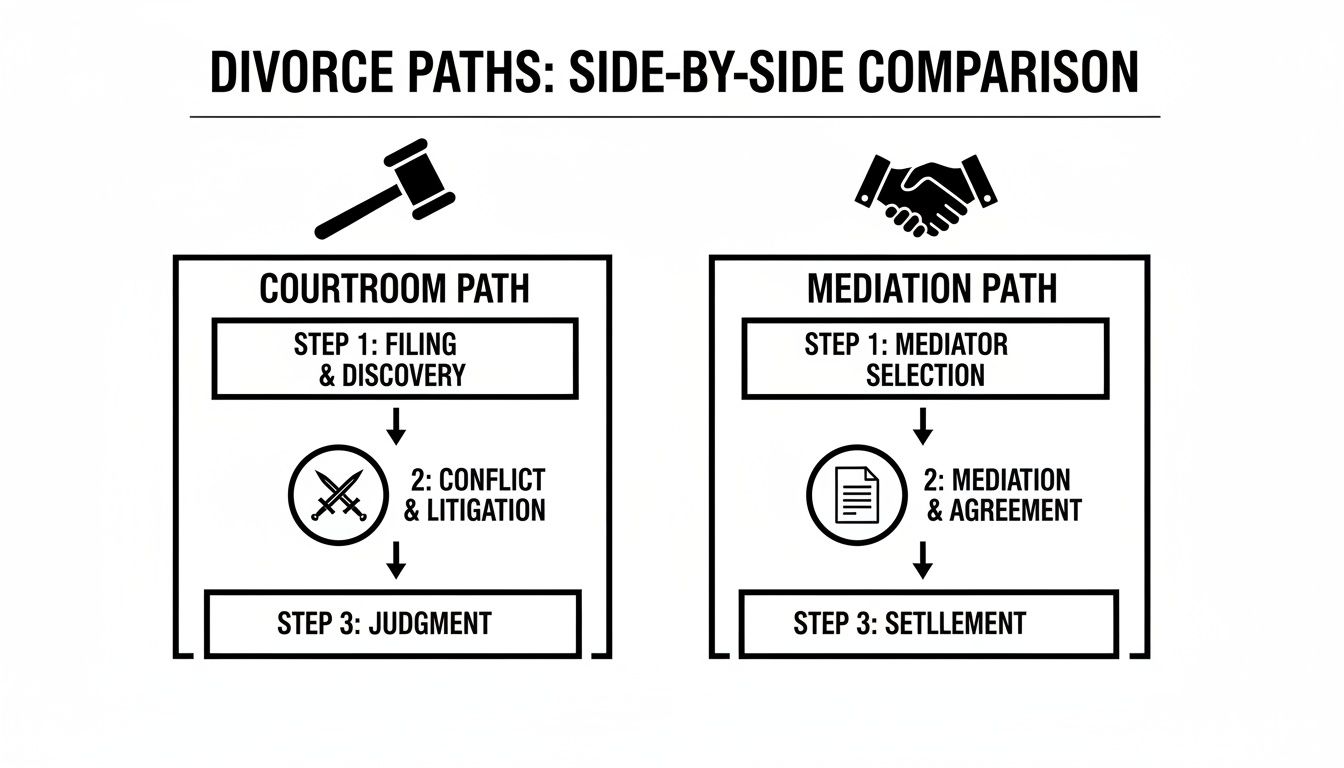
As you can see, the contrast is pretty stark. Mediation is built for collaborative agreement, while the courtroom often just leads to a longer, more painful fight.
Stage 1: Selecting Your Mediator
The first real step is choosing the neutral third party who will help guide your discussions. This is a joint decision—you and your spouse have to agree on the mediator. Usually, your attorneys will provide a list of respected professionals they trust and have worked with before, helping you pick someone with the right experience and personality for your unique situation.
Think of this person not as a judge, but as a skilled facilitator. A good mediator’s job is to create a safe, productive environment where both of you feel heard, keeping the conversation focused on solutions, not on who’s to blame.
Stage 2: The Mediation Session Structure
Most mediations kick off with a joint session where everyone is in the same room (or on the same video call). Here, the mediator lays out the ground rules, explains how confidentiality works, and clarifies their role. This is also when you and your spouse, alongside your attorneys, will each give a brief overview of your positions on the main issues.
After that initial meeting, the process typically breaks out into private sessions, which are called caucuses.
- Private Caucuses: The mediator will meet with you and your attorney in one room, and your spouse and their attorney in another.
- Confidential Discussions: These talks are completely private. Anything you say in a caucus stays there unless you give the mediator explicit permission to share it with the other side.
- Exploring Options: This setup is huge. It gives you the freedom to talk candidly about your real priorities, your biggest concerns, and where you might be willing to bend, all without the pressure of having your spouse in the room.
The mediator essentially acts as a shuttle diplomat, moving between the two rooms. They carry offers, counter-offers, and new ideas back and forth, working to find the middle ground and close the gap between you and your spouse. It’s a format that allows for honest negotiation that would be nearly impossible face-to-face.
Stage 3: Reaching an Agreement
As the day goes on and you both start finding common ground, the mediator helps you nail down the specifics of your settlement. The ultimate goal is to get a signed deal on every single issue in your divorce, from how to divide the 401(k) to who gets the kids for Thanksgiving. For a deeper dive into the nuts and bolts, you can learn more about mediation in a Texas family law case in our detailed guide.
Once you’ve agreed on everything, the mediator drafts a Mediated Settlement Agreement (MSA). This is, without a doubt, the most important document you’ll create during the entire process.
Under Texas Family Code §6.602, a properly written MSA is binding and irrevocable the moment it’s signed by both parties and their lawyers. What does that mean? It means once you sign on the dotted line, the deal is done—you can’t just change your mind later. This finality gives you the certainty and closure you need, ensuring all your hard work is protected and will be honored by the court. The MSA becomes the blueprint for your Final Decree of Divorce.
Understanding the Financial Investment in Mediation
Let’s talk about the money. The thought of unpredictable legal bills can add a huge amount of stress to an already difficult time, and that’s completely understandable. This is one of the biggest areas where divorce mediation really shines. It helps to stop thinking of it as just another expense and start seeing it as an investment in a calmer, more predictable, and more efficient outcome for your family.
When you put the cost of mediation side-by-side with the often-skyrocketing expenses of a traditional courtroom battle, the difference is night and day. A fight in court means paying for court fees, endless billable hours for attorneys handling discovery and trial prep, and maybe even bringing in expensive expert witnesses. Those costs pile up fast, leaving you with a financial hangover that can stick around long after the divorce is finalized.
Breaking Down the Costs of Mediation
Mediation, on the other hand, is much more straightforward financially. Mediators in Texas usually charge by the hour, and that hourly rate is split right down the middle between you and your spouse. Just like that, your individual cost is cut in half.
Of course, the total investment for mediation can vary based on a few key things:
- Complexity of Assets: If your estate is fairly simple, you’ll spend less time than a couple who needs to untangle business valuations or sort through multiple real estate properties.
- Level of Disagreement: Couples who are already on the same page about most things might only need a half-day session. More heated situations, however, might call for one or more full days to work everything out.
- Number of Issues: The more ground you need to cover—from custody schedules to dividing up a complex 401(k)—the more time you’ll likely need with the mediator.
This clear, hourly model gives you a sense of control over the cost that you just don’t get with litigation. You’re paying for focused, productive time that is 100% dedicated to finding solutions that work for you.
The Financial Advantage of a Mediated Agreement
So, what are we talking about in real numbers? The average cost of divorce mediation here in the Lone Star State runs from $100 to $500 per hour, which is a fraction of what litigation typically costs. For a process that might last a few hours or span a couple of sessions, most couples can expect to invest somewhere between $1,500 and $5,000 total. Compare that to a contested divorce that often blows past $15,000 once you factor in all the attorney fees, discovery, and trial preparation.
This massive financial difference is a big reason why Texas courts are increasingly requiring couples to try mediation before they’ll even consider letting a case go to trial.
By investing in mediation, you are not just saving money. You are preserving your financial and emotional resources for the future, allowing you to start your next chapter on solid ground.
Ultimately, it comes down to how you want to use your resources during this transition. For most people, the choice becomes pretty clear. If you’re weighing your options, our firm has explored in detail why to choose mediation as a path toward a more constructive outcome. Think of it as an investment in a process that protects your assets, your well-being, and your family’s future.
Resolving The Core Issues Of Your Divorce
This is where the real work happens. Mediation is the room where you and your spouse sit down to untangle a shared life and answer the tough questions about your future. A Texas divorce really boils down to three big pillars: how you’ll divide your property, what the parenting plan for your children will look like, and how any necessary financial support will be handled.
The beauty of mediation is that it gives you the space to address each of these with a level of creativity and personal attention that a courtroom just can’t offer.

This process is all about turning potential courtroom battles into constructive conversations. It empowers you to build practical, personalized solutions that a judge, who is bound by strict legal formulas, simply might not be able to order.
Dividing Your Marital Estate Fairly
Let’s start with the property. Texas is a community property state, and that concept is at the heart of any divorce negotiation. According to the Texas Family Code §3.002, pretty much any property or debt that either of you acquired during the marriage is considered to belong to both of you jointly. This covers everything from the house and cars to retirement accounts and credit card balances.
In front of a judge, the goal is to divide this community estate in a “just and right” manner, which usually translates to a straight 50/50 split. Mediation, however, lets you be much more strategic.
- Creative Solutions: You aren’t stuck with a rigid, one-size-fits-all division. For example, one spouse could keep the family home, and in exchange, the other might receive a larger portion of a retirement account. This allows both of you to walk away with the assets that matter most to your individual futures.
- Business Valuations: If you own a family business, mediation is the perfect place to work out sophisticated agreements like buyouts or structured payments that protect the company’s viability while ensuring a fair split for both spouses.
- Handling Debt: Instead of just slicing debts down the middle, you can assign them based on who is in a better position to manage them.
This flexibility is a massive advantage. It puts you in the driver’s seat to craft a property division that actually makes sense for your new financial lives.
Crafting A Child-Centered Parenting Plan
For any parent, the top priority is protecting your children’s well-being. Mediation provides the ideal setting to create a detailed and customized parenting plan that truly serves your child’s best interests, going far beyond the standard schedules a court might impose.
The legal lingo in Texas for custody is conservatorship (who gets to make key decisions for the child) and possession and access (the visitation schedule). In mediation, you can work together to build a plan that fits your family’s unique rhythm.
Instead of a judge imposing a one-size-fits-all schedule, you and your co-parent can design a plan that accounts for your work schedules, your children’s extracurricular activities, and unique family traditions.
Think about it: a standard possession order might be impossible for a parent who is a firefighter with an irregular shift schedule. In mediation, you can build a custom calendar that guarantees that parent has meaningful, consistent time with the children. This kind of collaboration fosters a much stronger co-parenting relationship from day one.
Arranging Financial Support With Clarity
The final pillar is financial support, which covers both child support and spousal maintenance. While Texas has specific guidelines for calculating child support, mediation allows you to address the nuances behind the numbers.
Child support is often a fairly straightforward calculation, but you can also negotiate other child-related financial responsibilities. This could include agreements on how to pay for future college expenses, sports or music lessons, or health insurance deductibles. If you want to dive deeper, our guide on whether you can negotiate child support during mediation is a great resource.
Spousal maintenance, sometimes called alimony, is less common in Texas and comes with strict eligibility rules in court. In mediation, however, spouses can agree to a period of contractual alimony to help one person get back on their feet financially, even if they wouldn’t technically qualify for it under the law. This collaborative approach helps ensure both of you can move forward with a sense of stability.
How to Prepare for a Successful Mediation
Success in Texas divorce mediation doesn’t just happen on the day of. It starts long before you ever walk into the room. Honestly, solid preparation is the single biggest factor in getting a good outcome.
Think of it like a high-stakes business meeting. You wouldn’t just show up and wing it, right? You’d have your files, your numbers, and a clear goal. Doing this homework transforms you from someone just reacting to offers into a proactive problem-solver, ready to build a fair and lasting agreement.

Gather Your Financial Documents
The bedrock of any discussion about dividing property is a crystal-clear financial picture. You simply can’t negotiate what you don’t fully understand. Before you even think about mediation day, you and your attorney need to get all the relevant financial documents together and organized.
This isn’t just about making a big stack of papers. It’s about creating a complete snapshot of your marital estate. This level of transparency is absolutely essential for productive talks and helps head off future fights over hidden assets or surprise debts.
Key documents you’ll need to round up include:
- Income and Tax Records: Recent pay stubs for both you and your spouse, plus your tax returns from the last 2 to 3 years.
- Asset Statements: This means bank account statements, summaries for retirement accounts like a 401k or IRA, and reports from any investment portfolios.
- Property Information: Deeds for any real estate, titles for vehicles, and the most recent mortgage statements.
- Debt Records: All credit card statements, loan paperwork, and documents for any other outstanding debts.
Having all this organized and at your fingertips saves a ton of time during the actual mediation and shows everyone you’re there to negotiate in good faith.
Define Your Goals and Priorities
Look, mediation is a process of give and take. It’s almost certain you won’t get 100% of everything you want on every single issue, and that’s perfectly normal. The secret is knowing what matters most to you before the negotiations even start.
Take some quiet time to really think through your ideal outcomes versus what you can live with. This exercise isn’t about wishful thinking; it’s about figuring out where you have room to be flexible and where you need to hold your ground.
Make a confidential list of your priorities. Rank them from “must-haves” down to “nice-to-haves.” This becomes your personal roadmap, guiding both you and your attorney and keeping you focused on what’s truly important for your future and your kids’ well-being.
For example, is keeping the family home your absolute top priority, even if that means getting a smaller piece of a retirement fund? Or is having more cash on hand more critical for your fresh start? Knowing the answers to these kinds of questions beforehand gives you a powerful strategic advantage.
Adopt a Collaborative Mindset
Finally, your attitude can make or break the entire mediation. It’s completely natural to feel hurt, angry, or frustrated. But walking into mediation with a combative mindset is a surefire way to hit a brick wall. The goal isn’t to “win” or rehash every argument from the past; the goal is to find practical solutions for your future.
This means being willing to actually listen to your spouse’s point of view, even if you flat-out disagree with it. It means shifting your focus from placing blame to solving problems. An experienced attorney is invaluable here, helping you separate the raw emotions from the practical, business-like decisions that have to be made. By adopting a forward-looking approach, you create an environment where a real, mutually beneficial agreement can actually happen. This is your chance to build a solid foundation for the next chapter of your life.
From Agreement to Final Decree
Reaching a full agreement in mediation feels like a monumental achievement. It’s often a moment of profound relief on what can be a long and difficult journey. But what happens next? This final stage is all about turning the collaborative decisions you’ve made into a legally binding reality, giving you the closure and certainty needed to move forward.
The cornerstone of this whole process is the Mediated Settlement Agreement (MSA). Once you, your spouse, and your respective attorneys have all signed this document, it holds incredible power under Texas law.
The Power of the Mediated Settlement Agreement
Don’t think of the MSA as just a summary of your discussion; it’s a legally enforceable contract. Under Texas Family Code §6.602, a properly signed MSA becomes irrevocable. That’s a powerful word. It means once the ink is dry, neither party can just wake up the next day with buyer’s remorse and back out of the deal.
This provision is specifically designed to give you peace of mind. It ensures that all the hard work, negotiation, and compromise you put into your Texas divorce mediation is protected and will be honored by the court, stopping the whole case from unraveling later on.
Drafting the Final Decree of Divorce
With the signed MSA in hand, the next job is to draft the Final Decree of Divorce. This is the official court order that actually, legally dissolves your marriage. One of the attorneys—and this is usually decided during the mediation itself—will take the lead on drafting the decree.
The Final Decree of Divorce must perfectly mirror the terms laid out in your MSA. It translates every single point of your agreement, from who gets the house to the details of the parenting plan, into the formal language the court requires.
Think of it this way: the MSA is the detailed blueprint you and your spouse created together. The Final Decree is the official, legally recognized structure built from that exact blueprint. Before it ever goes to the judge, both you and your spouse (through your attorneys) will get a chance to review the draft decree to make absolutely sure it perfectly reflects what you agreed to.
Once everyone signs off, the proposed decree is submitted to the judge for their signature. The judge’s signature is what makes it a final, binding court order. That is the very last formal step in your divorce, officially closing one chapter of your life and allowing you to begin the next with clarity and legal certainty.
Common Questions About Divorce Mediation in Texas
It’s completely natural to have questions as you start looking into Texas divorce mediation. The more you understand the process, the more confident you’ll feel about moving forward. Let’s tackle some of the most common concerns we hear from clients, offering straightforward answers to help you get prepared.
Is Mediation Mandatory in Texas?
This is probably one of the most frequent questions we get, and the answer isn’t a simple yes or no. While Texas law doesn’t automatically force every single divorce into mediation, the reality is that most judges will order it before they let a case go to a full-blown contested trial.
Under the Texas Family Code, judges have the power to refer couples to mediation, strongly encouraging them to find a settlement. In fact, many counties—especially major ones like Harris, Travis, and Dallas—have local rules or standing orders that make mediation a mandatory step for any contested family law case. The court’s perspective is clear: they want to give you and your spouse every chance to resolve things on your own terms before taking up the court’s valuable and limited time.
Why Do I Still Need My Own Lawyer?
This is a critical point to understand. A mediator isn’t on anyone’s “side.” Their role is to be a neutral third party, a facilitator who guides the negotiation. They can’t give you legal advice or tell you if you’re getting a good deal. That’s not their job.
This is exactly why having your own experienced attorney is so crucial. Your lawyer is there to:
- Explain your legal rights and what you could realistically expect if you went to court.
- Help you map out a negotiation strategy and figure out what’s most important to you.
- Protect you from agreeing to a settlement that is unfair, unworkable, or not in your best interest.
- Thoroughly review the final Mediated Settlement Agreement to make sure it’s legally sound and protects you.
Going into mediation without your own lawyer is like negotiating a major deal without understanding the terms. When looking for divorce mediation services, many people start their research online. Taking a look at examples of divorce and mediation website designs can give you an idea of how different professionals present their services and what kind of information you should be looking for.
Can Mediation Work If We Disagree on Everything?
Yes, absolutely. In fact, mediation is built for situations where spouses are far apart on the issues. A good mediator is trained in conflict resolution. They know how to lower the temperature in the room, get productive conversations going, and find common ground you might not even see.
The “caucus” format, where you’re in separate rooms, is especially powerful here. It allows you to speak openly and honestly with the mediator without the stress and pressure of being face-to-face with your spouse.
Texas divorce statistics really highlight why this matters. CDC data shows our state’s annual divorce rate is 1.9 per 1,000 residents, which is actually below the U.S. average. But here’s the key part: nearly 50% of those cases involve children under 18. For these families, mediation is invaluable for crafting custody and support agreements without a judge making those deeply personal decisions for them. You can discover more insights about Texas divorce statistics.
If you need help navigating divorce, custody, or estate planning in Texas, contact The Law Office of Bryan Fagan today for a free consultation.