
Facing the possibility of terminating parental rights—whether you are initiating the process or defending your own—can be one of life’s most difficult and emotionally charged transitions. It is a legal process that permanently severs the relationship between a parent and a child, and Texas courts do not take this step lightly. Understanding your rights and the legal path ahead is the first step toward navigating this overwhelming journey.
Understanding How Parental Rights Can Be Terminated in Texas

When a judge signs an order to terminate parental rights in Texas, it is not a temporary measure. It permanently dissolves every legal tie and responsibility a parent has to their child. Because the consequences are so final and irreversible, the law sets an incredibly high bar for any party asking the court to take this action. The person bringing the case must prove their claims with what the law calls “clear and convincing evidence.”
These profoundly serious cases arise from many different family situations. You might be a stepparent hoping to adopt your stepchild to provide them with the stability and legal recognition they deserve. You could be a grandparent who has stepped in to care for a grandchild and is concerned for their long-term safety. Or, you may be on the other side of the courtroom, fighting to protect your parental rights from what you believe is an unjust petition. No matter your position, the path forward can feel overwhelming without clear guidance.
The Court's Guiding Principle: A Two-Part Test
In any case involving a child that enters a Texas family courtroom, one question stands above all others: what is in the best interest of the child? This single principle guides every decision a judge makes, especially one as final as termination. To determine what is truly best for a child, the court must follow a specific, two-step process:
- Proving the Grounds: First, the person filing the lawsuit must prove that the parent has engaged in one or more of the specific actions outlined in the Texas Family Code. These are the legal "grounds" for termination and cover a range of conduct, from abandonment and neglect to endangering the child.
- Best Interest Analysis: Second, even if a legal ground is proven, that alone is not enough. The court must also find that ending the parent-child relationship is truly in the child's best interest. This is a separate and distinct finding.
This two-part test is a critical legal safeguard. It ensures that a parent’s rights are not severed unless there is a very serious reason and a thorough, forward-looking evaluation of the child’s well-being.
According to the Texas Family Code § 161.001, a court may order the termination of the parent-child relationship if it finds by clear and convincing evidence that the parent has engaged in one or more of the specified acts and that termination is in the best interest of the child.
This guide is designed to provide you with a clear, step-by-step explanation of this complex process. We will walk you through the legal grounds, the standards of proof, and what to expect at each stage, empowering you with the knowledge you need to face the future with confidence.
What Are the Legal Grounds for Terminating Parental Rights?
Before a Texas court will consider taking the drastic step of terminating parental rights, the person bringing the lawsuit must prove the parent's actions meet very specific legal criteria. This is not a vague standard based on personal opinions; the law is incredibly precise about what qualifies for such a severe and permanent measure.
The entire process hinges on a strict, two-part test designed to protect the parent-child relationship from being severed without a powerful, justifiable reason. First, you must prove the parent has committed at least one of the specific acts laid out in the Texas Family Code § 161.001. Second, and just as critically, you have to prove that terminating the parent's rights is in the best interest of the child. Both of these elements must be established with clear and convincing evidence for the court to move forward.
Common Grounds for Involuntary Termination
While the Texas Family Code lists numerous grounds, some situations appear in court far more often than others. Understanding these common reasons can provide a clearer picture of what a judge looks for when evaluating a termination case. Remember, every family's situation is unique, and the court will analyze the specific facts presented.
Here are some of the most common grounds for terminating parental rights in Texas:
- Endangerment: This is one of the most serious grounds. It means the parent knowingly placed or allowed the child to remain in conditions or surroundings that endanger their physical or emotional well-being. This can include exposure to domestic violence, ongoing drug or alcohol abuse in the home, or severe neglect.
- Abandonment: A parent may be found to have abandoned their child if they have voluntarily left the child with another person without providing adequate support and have remained away for a specified period.
- Failure to Support: If a parent has failed to support their child according to their ability for a period of one year (ending within six months of the lawsuit being filed), this can be used as a ground for termination.
- Criminal Conduct: A parent who engages in criminal conduct that results in their conviction and imprisonment can face termination, particularly if their time behind bars prevents them from providing care for the child. This is especially true if the crime was violent or involved injury to a child.
Information from public records can be crucial when establishing these legal grounds. For instance, a parent's criminal history and records from other court cases can serve as vital evidence. You can learn more by navigating public records and understanding their impact.
Proving the Case: The High Burden of Proof
Simply accusing a parent of these actions is not enough. The person who files the lawsuit—the petitioner—carries the entire burden of proof. This means they are responsible for presenting strong, credible evidence that convinces the judge the allegations are true.
Let's walk through a practical example. Imagine a mother files a petition to terminate the rights of her child's father, claiming he endangered the child because of his chronic substance abuse.
Scenario: Endangerment Through Substance Abuse
To prove her case with clear and convincing evidence, the mother might present police reports from incidents at the father’s home, failed drug test results, testimony from teachers or counselors who have observed the child's distress, and perhaps even testimony from the father’s own family members about his inability to provide a safe environment.
This level of proof is what "clear and convincing" means in practice. It must be more than just a possibility; the evidence must create a firm belief or conviction in the judge's mind that the allegations are true.
The Texas Family Code lists 25 distinct grounds for termination, and our state is known for having an incredibly high standard for evidence. Interestingly, Texas is also one of only two states where the median time to termination is less than a year, which shows just how critical it is to take immediate and decisive action.
Ultimately, even if a ground is proven, the court's final decision will always circle back to that second, all-important question: what is truly in the child’s best interest? Proving a statutory ground simply opens the door for the court to consider that critical issue.
The court process for severing a parent-child relationship can feel like a confusing and intimidating maze. When your parental rights are on the line, knowing what’s coming can make a world of difference. The process officially begins when someone files a formal document called a "Petition for Termination" with the court.
This petition is usually filed by the other parent, a concerned family member, or—in many cases—the Texas Department of Family and Protective Services (DFPS) if they believe a child is in danger. Once that document is filed, the lawsuit officially begins, setting a series of legal steps and strict deadlines into motion.
The Initial Stages of the Lawsuit
After the petition is filed, the first critical step is to officially notify the parent whose rights are at stake. This is called "service of process," and it involves personally delivering a copy of the lawsuit to them. This is not just a courtesy; it is a constitutional right designed to ensure the parent is fully aware of the proceedings and has a fair opportunity to respond and defend their rights.
Once service is complete, the court will schedule one or more initial hearings. These early meetings are focused on setting the ground rules for the case. A judge will issue temporary orders, establish timelines, and, most importantly, appoint an attorney ad litem. This is a neutral, court-appointed attorney whose sole duty is to represent the child’s best interests throughout the legal battle.
The attorney ad litem acts as the child's voice in the courtroom. They investigate the situation, speak with everyone involved—parents, teachers, relatives—and then make recommendations to the judge based on what they believe is truly best for that child's future.
Gathering Evidence and Preparing for Trial
Following the initial hearings, the case moves into the discovery phase. Think of this as the investigation stage, where both sides work to gather the evidence needed to build their arguments. This is a formal process that uses specific legal tools:
- Requests for Production: Each side can legally demand relevant documents from the other, such as financial records, emails, text messages, or medical reports.
- Interrogatories: These are written questions that the other party must answer in writing, under oath.
- Depositions: This is out-of-court testimony where a witness answers questions from an attorney under oath, with a court reporter transcribing every word. It’s a way to preserve a witness's story before trial.
This phase is where the facts are uncovered—facts that will either support or undermine the grounds for termination. For a closer look at how these grounds are established, you can learn more about involuntary termination of parental rights in our detailed article. All the information gathered during discovery shapes the arguments that will ultimately be presented to the judge at the final trial.
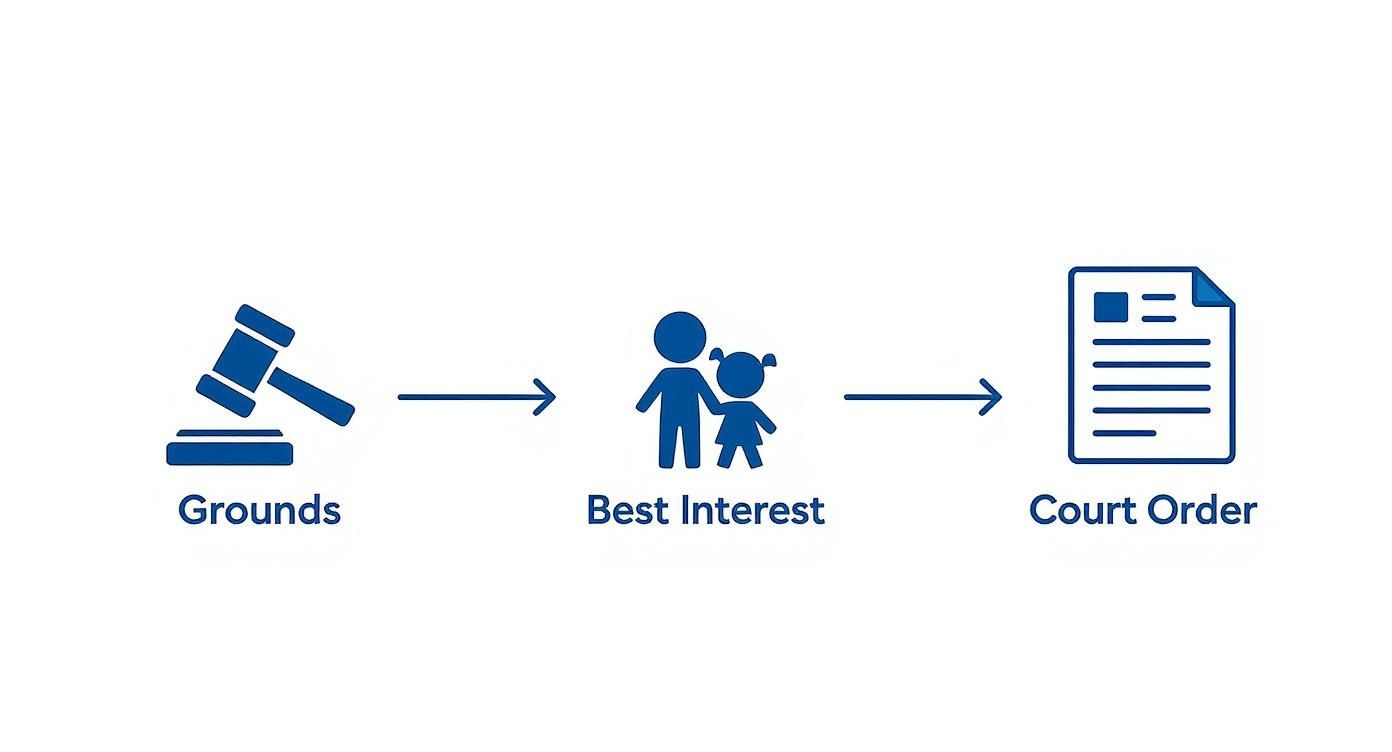
This flowchart illustrates the essential two-part test: proving a legal ground is just the first step. The court must also be fully convinced that termination is genuinely what’s best for the child’s future.
An Expedited Timeline Demands Swift Action
It is crucial to understand that Texas law does not allow these cases to drag on. The law requires judges to manage termination lawsuits on an expedited timeline. The goal is to provide stability for the child as quickly as possible, preventing them from being left in legal limbo.
This table provides a simplified look at how an involuntary termination case typically progresses.
Typical Timeline of a Texas Termination Case
| Phase | Key Actions | Typical Timeframe |
|---|---|---|
| Filing & Service | A Petition for Termination is filed. The respondent parent is formally served with the lawsuit. | 1-3 weeks |
| Initial Hearings | The court holds temporary orders hearings and appoints an attorney ad litem for the child. | 2-6 weeks after service |
| Discovery | Both sides exchange information through requests, interrogatories, and depositions. | 3-6 months |
| Mediation | Parties attempt to reach a settlement agreement with a neutral third-party mediator. | Within 6-8 months |
| Final Trial | If no settlement is reached, the case proceeds to a final trial before a judge. | Within 12 months of filing |
The fast pace of these cases means there is absolutely no time to waste. From the moment you are served with a petition, the clock is ticking, and every day matters. Securing experienced legal guidance immediately is essential to protect your rights and build the strongest possible case.
What Is the "Best Interest of the Child"? Understanding the Holley Factors
When it comes to terminating parental rights in Texas, every piece of evidence and every argument ultimately leads to one powerful question: what is truly in the best interest of the child? This is not a vague concept—it is the absolute legal standard a judge must use to make their final, life-altering decision.
Even if a parent has committed an act that legally justifies termination, the court cannot sever that parent-child bond unless it also finds that doing so is what’s best for the child’s physical, emotional, and developmental well-being. It’s a two-part test, and this second part is the most critical.
To answer this complex question, Texas courts rely on a specific set of criteria known as the “Holley Factors.” These factors originated from a landmark Texas Supreme Court case, Holley v. Adams, and they provide a structured framework for examining a child's entire situation from every possible angle.
What Are the Holley Factors?
The Holley Factors serve as a guide, not a rigid checklist. A judge may consider other relevant information, but these specific points form the core of their analysis. Think of them as different lenses a judge uses to see the complete picture of a child's world and what their future could look like.
A judge will carefully weigh evidence related to each of these areas:
- The emotional and physical needs of the child, both now and in the future. This extends beyond basic needs like food and shelter to include their need for love, stability, and guidance.
- The emotional or physical danger the child faces, now or in the future. The court will look for any history of abuse, neglect, or exposure to harmful environments.
- The parental abilities of the individuals seeking custody. This is a direct comparison: who is better equipped to provide a stable, nurturing home?
- The programs available to assist these individuals in promoting the child's best interest. For example, is a parent actively attending counseling, completing parenting classes, or participating in a substance abuse program?
- The plans for the child by those seeking custody. What does the future actually look like for the child in each potential home?
- The stability of the proposed home. A judge wants to see a consistent, safe, and predictable environment where a child can thrive.
- Acts or omissions by the parent that demonstrate the existing parent-child relationship is not a healthy one.
- Any excuse for the parent's acts or omissions. The court will consider the "why" behind a parent's actions, though excuses have their limits.
It's crucial to understand that these factors are not a scoreboard where one side simply tries to rack up more points. A judge uses them to conduct a holistic, in-depth review of the child's life to determine what will truly serve their long-term welfare.
How the Factors Work in Practice
Let’s apply this to a real-world scenario. Imagine a stepparent wishes to adopt a child, which would require terminating the parental rights of the child's biological father. The father has struggled with substance abuse and has been inconsistently involved in the child's life for years.
The court would apply the Holley Factors to this situation:
- Danger to the Child: A judge would view the father’s substance abuse as a clear potential for both physical and emotional danger.
- Parental Abilities: They would compare the stepparent’s proven track record of providing a stable, loving home against the father’s documented struggles.
- Stability of the Home: The child's current life with their mother and stepparent is stable and predictable, whereas the father’s situation may be chaotic.
- Acts or Omissions: The father’s failure to maintain consistent contact, provide financial support, or be a steady presence would be a major consideration.
By carefully weighing these and other elements, the judge can make a well-reasoned, evidence-based decision. The court’s goal is to find the outcome that gives the child the best possible chance for a safe, healthy, and stable future. To see a more detailed breakdown, you can read about the key factors judges consider at a termination of parental rights hearing in our comprehensive article. Understanding this framework is essential for anyone involved in these emotionally charged proceedings.
What is Voluntary Termination and How Does it Work with Stepparent Adoptions?
When people hear "termination of parental rights," it often brings to mind contentious courtroom battles. However, in many Texas families, the process is cooperative, driven by a shared desire to give a child the most stable and legally secure home possible. This is particularly common in cases involving a stepparent adoption.
Here, one biological parent agrees to voluntarily relinquish their rights, allowing a stepparent who has become a true parental figure to formally and legally assume that role. This is a powerful way to make a blended family whole in the eyes of the law, giving the stepparent the authority to handle everything from medical decisions to school enrollment.

The Affidavit of Relinquishment of Parental Rights
The central legal document in a voluntary termination is the Affidavit of Relinquishment of Parental Rights. This is more than a simple form; it is a sworn, legally binding statement in which a parent formally declares their intent to give up all legal rights and duties concerning their child.
The Texas Family Code is incredibly strict about how this document is executed to prevent coercion. It must be signed by the parent after the child is born and witnessed by two credible adults and notarized. These formalities ensure the decision is deliberate, fully understood, and made without undue pressure. For more details, you can read our guide on understanding the process of giving up parental rights in Texas.
The Judge's Final Approval is Still Required
Even with a signed affidavit, the process is not automatic. A judge must still give the final approval. Whether the termination is voluntary or contested, the court’s core mission remains the same: to act in the best interest of the child.
A judge will not simply "rubber-stamp" a termination if it means leaving the child with only one legal parent and no one else to step into that role. This is why voluntary termination is almost always linked to a stepparent adoption. The court needs to see a clear, seamless plan where another loving, capable adult is ready to immediately assume the legal responsibilities of the parent whose rights are being terminated.
Scenario: A Stepparent Adoption
Imagine a stepfather has been a constant, loving presence in his stepson's life for years. The biological father lives in another state and has not had contact for a long time. The family decides it is time for the stepfather to adopt the boy legally. The biological father agrees and signs an Affidavit of Relinquishment. In court, the judge sees a stable home, a dedicated stepparent waiting to adopt, and a consenting biological parent. For the judge, the path is clear: terminating the biological father's rights to allow the adoption is undoubtedly in the child's best interest.
This legal process transforms a family's day-to-day reality into a legal certainty, offering profound security for the child and true peace of mind for the entire family.
The Permanent Consequences of a Termination Order
A court order terminating parental rights is not a temporary setback. It is a final, irreversible decision with lifelong consequences for both you and your child. Fully grasping the gravity of this order is critical for anyone involved in these proceedings, because once that legal door is closed, it is nearly impossible to ever open it again.
The moment a judge signs a termination order, every legal tie connecting you to your child is permanently severed. The law views it as a complete and total end to the parent-child relationship.
What a Termination Order Legally Ends
The impact of a termination order is absolute and far-reaching. For the parent whose rights are terminated, the order immediately ends:
- All Rights to Decision-Making: You lose all legal authority to make choices about your child's schooling, medical care, or religious upbringing.
- All Rights to Possession and Visitation: Any court-ordered schedule for seeing or spending time with your child is instantly and permanently voided.
- The Obligation for Future Child Support: Your legal duty to make ongoing child support payments ceases on the date the order is signed. However, this does not erase any past-due child support (known as arrears); you are still legally responsible for that debt.
For the child, the impact is equally profound. A termination order severs their legal tie to that parent, including the right to inherit from that parent if they pass away without a will. In the eyes of the law, a fundamental part of their family tree has been legally removed.
The finality of a termination order cannot be overstated. Unlike custody orders, which can be modified as circumstances change, a termination decree is designed to be permanent. Attempting to appeal or reverse one is an incredibly rare and difficult legal battle with a very low chance of success.
This permanence underscores the high stakes in these cases. The court’s decision is meant to create a final, stable foundation for the child’s future, freeing them from legal uncertainty. It is why having dedicated, compassionate legal representation is not just advisable—it is a necessity to protect your rights and your family's future.
Answering Your Hard Questions About Terminating Parental Rights
The idea of terminating parental rights brings a storm of difficult emotions and complex legal questions. As you navigate this challenging process, it is completely normal to have concerns about how it works and what it means for everyone involved. Here are some straightforward answers to the questions we hear most often from our clients.
Can I Terminate My Rights to Stop Paying Child Support?
No. A Texas court will never grant a termination if the primary motivation is to avoid a child support obligation. The court's single guiding principle is the child's best interest, and financial support is a critical component of that. A termination is generally only considered if another qualified adult, such as a stepparent, is ready and willing to step into your shoes by adopting the child. This action legally and financially secures the child's future, ensuring their stability is not compromised.
What Happens If the Other Parent Cannot Be Located?
Even if a parent's whereabouts are unknown, a lawsuit for terminating parental rights in Texas can still proceed. The law provides alternative methods for providing legal notice in these situations. Methods like "service by posting" at the courthouse can be used to fulfill the notice requirement, allowing the case to move forward. It is a serious mistake to believe that ignoring or avoiding a lawsuit will make it go away. In reality, failing to respond places your parental rights in immediate and serious jeopardy, as the court may proceed without your input.
Does a Termination Order Cancel Past-Due Child Support?
No, it does not. A termination order is forward-looking; it stops future child support obligations from accruing from the date the judge signs it. However, it does nothing to erase any existing child support debt, often called arrears. The parent who owes that back child support remains legally responsible for every penny. The Office of the Attorney General will continue to pursue collection on any money owed up to the date the termination was finalized.
Can a Termination of Parental Rights Be Reversed?
Reversing a final termination order is almost impossible. It is an incredibly steep and difficult legal battle. While a parent can file an appeal immediately after a trial if there were specific legal errors, the chances of successfully overturning a final order are very slim. This fact underscores the profound and permanent nature of the court's decision and is precisely why these cases are handled with such gravity from the very start.
If you need help navigating divorce, custody, or estate planning in Texas, contact The Law Office of Bryan Fagan today for a free consultation.