
Many Texans live in committed, long-term relationships without ever having a formal wedding, often raising a critical question down the line: “Are we actually married in the eyes of the law?” As experienced family law attorneys at The Law Office of Bryan Fagan, PLLC, we understand the uncertainty and stress this question can cause. The answer is complex, as Texas recognizes informal relationships, often called common law marriages, but not based on the myth of living together for a certain number of years. The state has a very specific, three-part test outlined in the Texas Family Code to determine if your relationship legally qualifies as a marriage, and understanding these common law marriage Texas requirements is crucial for protecting your family, your property, and your future.
Understanding Texas Common Law Marriage Requirements

Whether your relationship is legally recognized has massive implications for everything from property division and inheritance rights to child custody and benefits. The rules are laid out clearly in the Texas Family Code § 2.401, and getting them right is non-negotiable. At The Law Office of Bryan Fagan, PLLC, our expertise is grounded in helping clients navigate these statutes with confidence and clarity.
The Foundational Prerequisite: Capacity to Marry
Before you even get to the three main tests, there’s a fundamental hurdle every couple must clear: you both must have the legal capacity to marry.
Think of this as the ticket you need just to get into the stadium. It means both partners must be at least 18 years old, not currently married to anyone else, and not closely related in a way that Texas law prohibits. If you don’t meet these basic requirements, nothing else matters—no amount of time, public declarations, or living together can create a valid marriage.
The Three Core Tests for a Common Law Marriage
To prove an informal marriage exists, you need to show “clear and convincing evidence” that all three of the following elements were true at the same time. It’s an all-or-nothing deal.
- An Agreement to Be Married: This is the big one. Both of you had to agree, right then and there, that you were married. It’s not about promising to get married someday in the future. It’s a present agreement to be a married couple, creating an immediate and permanent marital bond.
- Living Together in Texas: You must have cohabitated—lived together under the same roof—in Texas. The key here is that you were living together as a married couple, sharing a home and building a life together.
- Holding Yourselves Out as Married: This is about public perception. You had to present yourselves to others—your friends, family, and community—as a married couple. This is often called establishing a “reputation” for being married. Did you introduce each other as “my husband” or “my wife”? Did you file joint tax returns? That’s the kind of evidence that counts.
Again, there’s no magic number of years you have to live together. Courts look at the whole picture to see if your actions and intentions meet these strict criteria. For more details, the Texas Bar offers some great insights.
For couples wondering where they stand, we’ve put together a quick reference table to break down these legal requirements.
Quick Guide to Texas Common Law Marriage Requirements
This table summarizes the three core legal tests and the foundational capacity requirement for establishing a valid common law marriage in Texas.
| Requirement | What It Means in Practice | Texas Family Code Section |
|---|---|---|
| Capacity to Marry | Both partners are over 18, not currently married to anyone else, and not too closely related. | § 2.001 et seq. |
| Agreement to Be Married | A mutual, present-day agreement that you are married, not just planning to marry later. | § 2.401(a)(2) |
| Living Together in Texas | You must share a home and live together within the state of Texas as a married couple. | § 2.401(a)(2) |
| Holding Out to the Public | You consistently present yourselves to others (family, friends, community) as being married. | § 2.401(a)(2) |
This isn’t just about a legal title. When children are involved, the stability and legal recognition of your relationship directly impact their security, access to benefits, and overall well-being. The emotional and academic health of a child often depends on the stability that a legally recognized family unit provides.
If you’re unsure about your marital status or need to prove its existence for a legal matter, the stakes are too high to leave it to chance. The best move is to get clarity. Schedule a consultation with the experienced family law attorneys at The Law Office of Bryan Fagan, PLLC today to protect your rights and your family’s future.
Proving Your Agreement to Be Married

Of the three prongs required to establish an informal marriage in Texas, proving a mutual agreement to be married is usually the toughest nut to crack. This isn’t about some future plan, like an engagement. It’s about a present, mutual understanding that—right here, right now—you are a married couple.
Without this clear, present-tense agreement, the other two elements (living together and holding yourselves out as married) can easily be dismissed by a court. A judge might see them as signs of a committed relationship, but not a legal marriage. And importantly, the burden of proof falls squarely on the shoulders of the person claiming the marriage exists.
This “agreement” doesn’t have to be a signed contract. What Texas courts are really looking for is evidence of a “meeting of the minds.” It’s the collection of spoken and unspoken actions that show your relationship fundamentally shifted from just dating to being a single marital unit.
Evidence of a Present Intent to Marry
To prove this agreement existed, your actions have to speak just as loudly as your words—though words certainly matter, too. Courts will comb through your behavior and documents to figure out if a true agreement was ever in place. The strength of your claim will hinge on how consistent and clear that evidence is.
Some of the most powerful proof you can offer includes:
- Exchanging Rings: The simple act of giving and wearing rings is a classic, powerful symbol of marriage. It serves as strong circumstantial evidence that you both agreed to be married.
- Filing Joint Tax Returns: When you sign a tax return as “married filing jointly,” you are declaring to the government, under penalty of perjury, that you consider yourselves a married couple. This is a big one.
- Referring to Each Other as Spouses: Do you consistently call each other “my husband” or “my wife” when talking to family, friends, and even business contacts? This shows a shared, public understanding of your marital status.
At The Law Office of Bryan Fagan, PLLC, we often emphasize that a single piece of evidence is rarely enough. Our experience has shown that a judge looks at the complete picture you present to determine if an agreement was truly in place.
A Real-Life Scenario: The Case of Sarah and Tom
Let’s consider a hypothetical scenario to illustrate this point. Imagine a couple, Sarah and Tom, who lived under the same roof for a decade and raised a child together. Tom consistently introduced Sarah as his “partner” at social events. When they applied for a car loan, they both checked the “single” box on the application. Sarah, on the other hand, regularly told her family and friends they were “basically married.” If they were to separate, Sarah would face an uphill battle to prove a common law marriage.
In this scenario, the evidence for a mutual agreement is shaky and full of contradictions. Their actions don’t paint a picture of a clear, mutual decision to be married. This kind of ambiguity can have devastating consequences for their child. Without legal recognition of the marriage, the child’s inheritance rights could be called into question, and the lack of a clear family structure could create emotional instability, impacting their performance in school and overall well-being. Proving a consistent, shared agreement is essential for creating the stability every child deserves.
If you find yourself needing to prove—or disprove—an agreement to be married, the evidence you present is everything. The attorneys at The Law Office of Bryan Fagan, PLLC can help you gather the right documentation and build a solid case. Schedule a consultation with us today to discuss your specific situation and protect your family’s future.
Living Together and Presenting as a Married Couple

While proving you both agreed to be married can feel like the trickiest, most subjective hurdle, the final two common law marriage Texas requirements are all about your actions. This is where the rubber meets the road.
These two elements—living together and presenting yourselves as a married couple—are almost always proven together because they’re two sides of the same coin. They are the outward proof of that private agreement you made.
What Does “Living Together as Spouses” Really Mean?
The legal term here is cohabitation, but it’s much more than just having the same address or splitting the bills. Under Texas Family Code § 2.401, you have to live together as spouses. This means building a home and a life together, creating the kind of domestic partnership that looks and feels like a marriage to the outside world.
At the same time, you have to be holding out to the public that you’re married. Think of this as the reputation you build in your community. It’s the sum total of all your actions that lead friends, family, neighbors, and even businesses to see you as a married couple. It’s about what you say and, more importantly, what you do.
Building Your Case Through Everyday Actions
Evidence for these two requirements comes directly from the life you share. A judge is going to look for a consistent pattern of behavior that points to one conclusion: marriage. Think of each piece of evidence as a single thread. One thread might not be very strong, but when you weave enough of them together, you create a compelling story of your marriage.
Here’s the kind of practical evidence that helps build a strong claim:
- Shared Finances: Do you have joint bank accounts or shared credit cards? Is your partner listed as the primary beneficiary on your life insurance or 401(k)? These financial ties are powerful indicators.
- Official Paperwork: Filing joint tax returns is a huge one. So is listing each other as a spouse on health insurance applications or signing a lease or mortgage together as a married couple.
- Public Statements: How do you introduce each other? Consistently using terms like “my husband” or “my wife” at parties, work events, or when meeting new people is critical.
- Community Reputation: Does mail arrive addressed to “Mr. and Mrs. Smith”? Would your friends, family, or pastor be willing to testify under oath that they always considered you married?
Proving these elements is all about showing a consistent public identity. Contradictory behavior can sink your case. For instance, telling your friends you’re married but filing your taxes as “single” creates a major inconsistency that a court will notice, and it can create real instability for any children involved, disrupting the stable environment they need to thrive academically and emotionally.
Texas is one of a handful of states, like Colorado and Utah, that still recognizes common law marriage. When a Texas court has to decide if a marriage exists, they dig deep into evidence like joint accounts and public declarations to sort through the legal details. You can find out more about these legal standards and why they are so crucial in establishing marital rights.
A Real-Life Example: The Case of Mark and Jessica
Let’s look at a practical, hypothetical example. Mark and Jessica lived together for eight years and had a child together. They always introduced each other as “my spouse” at their child’s school events and were even listed as a married couple in their church directory. They also bought a home together, and both of their names are on the deed as joint tenants.
If they were to separate, Jessica could use the property deed, testimony from their pastor and other school parents, and joint bank statements to prove they met both requirements of cohabitation and holding out to the public. This evidence paints a clear picture of a stable, recognized family unit that their child relied upon—a critical factor when a court makes decisions about custody and support. The child’s sense of security is deeply rooted in this established family structure, and proving the marriage helps maintain that stability during a difficult transition.
Navigating these requirements isn’t always straightforward. If you find yourself needing to prove your marriage is valid, don’t hesitate to contact The Law Office of Bryan Fagan, PLLC for a consultation.
How Common Law Marriage Affects Your Children
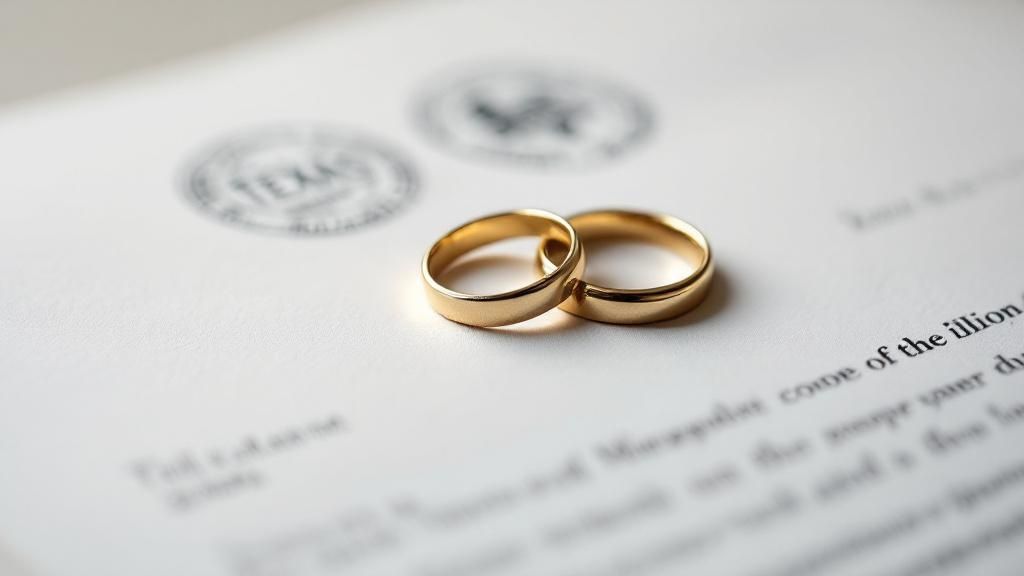
The legal status of your relationship is far more than just a label—it’s the very foundation of your children’s security. When kids are in the picture, understanding the common law marriage Texas requirements becomes absolutely critical, as their well-being is directly tied to the stability of your union.
In Texas, the law makes a powerful assumption: when a child is born to a married couple, the husband is legally presumed to be the father. This “presumption of paternity,” established in the Texas Family Code § 160.204, isn’t just for ceremonial marriages; it applies equally to common law marriages that have been legally proven. This automatic recognition is the key that unlocks a child’s access to a whole host of vital benefits.
The Importance of Legal Clarity for Children
When a marriage isn’t legally recognized, a child’s future can be left hanging in the balance. The benefits that depend on a parent’s marital status are both numerous and incredibly significant.
- Health and Financial Security: Legal parentage is what ensures a child can be added to a parent’s health insurance. It also makes them eligible for Social Security survivor benefits if a parent were to pass away.
- Inheritance Rights: A legally recognized child has undisputed rights to inherit, protecting their financial future if a parent dies unexpectedly.
- Emotional Stability: This might be the most important one. Legal certainty provides a stable environment for a child to grow up in. Kids thrive on security and predictability, and knowing their family unit is legally solid contributes immensely to their emotional health.
The ambiguity that comes from an unproven common law marriage can create tremendous stress and instability for a child, especially if the relationship ends. This uncertainty can ripple out, impacting their focus in school and their overall development.
A Hypothetical Scenario: The Cost of Ambiguity
Let’s imagine a couple, Maria and David. They’ve lived together for years, have a young son named Leo, and consider themselves married under common law. But when they decide to separate, things get complicated. Because they never filed a formal declaration, David disputes the marriage ever existed to try and avoid dividing their property.
Suddenly, before Maria can even start a conversation about a custody schedule or child support for Leo, she’s facing a costly and emotionally draining court battle just to prove their marriage was real. All the while, Leo is caught in the middle.
The lack of a clear parenting plan and consistent financial support creates an unstable home life. His grades start to slip, and he begins acting out at school. This entire heartbreaking situation could have been avoided if Maria and David had simply filed a Declaration of Informal Marriage. That one piece of paper would have provided the legal clarity needed to protect their son from the fallout of their separation.
If you have children and are in a common law relationship, taking the step to clarify your legal status is one of the most powerful things you can do to safeguard their future. Schedule a consultation with us today to discuss your options.
Debunking Common Myths About Informal Marriage
When it comes to common law marriage Texas requirements, there’s a lot of misinformation floating around. These myths can create a world of legal and emotional trouble, especially when kids are in the picture. It’s stunning how many people operate under false assumptions that can put their property rights and even their standing as a parent at risk. Our goal here is to cut through the noise and give you the facts.
One of the most stubborn myths out there is that you’re automatically married after living together for a certain number of years. The number you hear most often is seven. This is completely, 100% false. Texas law has no durational requirement for cohabitation. Your marital status is all about meeting the three legal requirements at the same time, not about how many pages you’ve torn off the calendar.
Myth Versus Fact
Let’s clear up some of the most common points of confusion to make sure you’re working with the right information.
- Myth: Ending a common law marriage is as simple as moving out.
- Fact: A legally established common law marriage is no different than a ceremonial one in the eyes of the law. Under the Texas Family Code, it has to be dissolved through a formal divorce. That means going through the official court process, which includes dividing property and sorting out child custody.
- Myth: Only a ceremonial marriage creates community property.
- Fact: Once a common law marriage is proven to exist, every asset acquired from the day that marriage began is considered community property. This property is then subject to a “just and right” division by a judge if you divorce.
The idea of informal marriage isn’t new; it has deep roots in Texas history, tracing back to traditions recognized by the U.S. Supreme Court way back in 1877. Fast forward to 2021, and Texas reported a marriage rate of 5.8 per 1,000 residents. This just goes to show how common marital unions—both formal and informal—are in our state. You can learn more about the benefits of common law marriage for Texas couples.
Plenty of other myths circulate about informal marriage, and getting the facts straight about the legal and financial implications is critical. For instance, it’s always a good idea to clear up any confusion around claiming a spouse as a dependent for tax purposes.
Believing these myths can throw a family into chaos, and it’s often the children who suffer most when their sense of stability is shaken by legal unknowns. If you’re not sure where you stand, don’t rely on what you’ve heard from friends or family. Schedule a consultation with The Law Office of Bryan Fagan, PLLC, and get the clarity you and your family deserve.
So, What’s Next? Protecting Your Legal Rights
Once you’ve navigated the tricky waters of Texas common law marriage, what you do next is critical. Whether you’re looking to make your union rock-solid or you’re facing the tough reality of a separation, your next steps carry serious legal weight for you and your family. The common law marriage Texas requirements can be a maze, but thankfully, the law offers clear paths forward.
Making a conscious choice right now can save you from a world of emotional and financial pain down the road. This is especially true when kids are in the picture. The legal clarity you create today is the foundation of security they need, no matter what your future holds.
Making It Official with a Declaration
If you and your partner want to erase any doubt about your marital status, the most straightforward way is to file a Declaration of Informal Marriage. This isn’t just another piece of paper; it’s a formal, legal document you both sign and file with your county clerk, as outlined in the Texas Family Code § 2.402.
Think of it as putting an official stamp on the marriage you’ve already built together. Filing this declaration has some real, tangible benefits:
- Legal Certainty: This document becomes the ultimate proof of your marriage. It makes it much easier to access spousal benefits like health insurance, Social Security, and inheritance rights without having to jump through hoops.
- Protection for Your Kids: It legally solidifies paternity, which secures your children’s rights and helps avoid potential court fights down the line.
- Peace of Mind: You won’t have to worry about proving the three common law elements later on—a process that can be incredibly stressful and expensive.
When It’s Time to Go Your Separate Ways
On the flip side, if your relationship is ending, you can’t just walk away. A legally recognized common law marriage in Texas has to be dissolved through a formal divorce, just like any ceremonial marriage.
This means you’ll have to tackle all the major legal issues that come with a divorce, including:
- Dividing Community Property: Any assets and debts you both acquired from the moment your informal marriage began are considered community property. A court will divide them in a “just and right” manner.
- Child Custody and Support: If you have children, the court will establish orders for conservatorship (custody), possession schedules, and child support to ensure they are cared for.
- Possible Spousal Support: In some situations, one spouse might be eligible for spousal maintenance, depending on the specifics of your marriage and breakup.
As you think about protecting your legal rights, it’s also a good time to consider the essential estate planning documents that will secure your future and your family’s inheritance.
The decisions you make during a divorce echo for years. If you don’t formally dissolve your common law marriage, your ex could legally claim property you acquire long after you’ve separated.
Given how much is at stake legally and financially, trying to handle this alone is a huge risk. The compassionate attorneys at The Law Office of Bryan Fagan, PLLC are here to help you figure out your options. Schedule a free consultation today to get the clarity and protection you and your family deserve.
Got Questions About Texas Common Law Marriage? We’ve Got Answers.
When you’re trying to figure out the ins and outs of an informal marriage, a lot of specific, and often urgent, questions tend to pop up. Here at The Law Office of Bryan Fagan, PLLC, we believe you deserve clear, straightforward answers to understand where you stand and how to protect your family’s future. Let’s dive into some of the most common concerns we hear from our clients about common law marriage in Texas.
Can Same-Sex Couples Have a Common Law Marriage in Texas?
Yes, without a doubt. Ever since the landmark U.S. Supreme Court decision in Obergefell v. Hodges, all Texas laws and requirements for establishing an informal marriage apply equally to every couple.
Same-sex couples just need to meet the very same three-part test as anyone else: you must agree to be married, live together in Texas as a married couple, and hold yourselves out to others as being married.
What Happens if My Common Law Spouse Dies Without a Will?
This is a situation where proving your marriage is absolutely critical. If you can successfully establish that you were in a common law marriage, Texas inheritance laws will recognize you as the legal surviving spouse.
This gives you significant rights, even if your partner passed away “intestate” (the legal term for dying without a will). Proving the marriage is the essential first step to securing your inheritance rights and protecting the life and assets you built together.
This legal recognition is vital for a child’s emotional and financial stability, ensuring they have access to survivor benefits and a clear line of inheritance, which provides a secure foundation during a difficult time.
Is There a Time Limit to Prove a Common Law Marriage After a Breakup?
Yes, and this is a deadline you absolutely cannot miss. The Texas Family Code § 2.401(b) puts a firm clock on this. If you don’t start a legal proceeding to prove the marriage within two years of separating, the law creates a “rebuttable presumption” that you and your partner never actually agreed to be married in the first place.
Waiting longer than two years makes your claim incredibly difficult to prove. When it comes to protecting your rights after a separation, timely action is everything.
If you have more questions or are facing a situation involving a common law marriage, don’t leave your future to chance. Contact The Law Office of Bryan Fagan, PLLC to schedule a consultation and get the experienced legal guidance you deserve.