
Have you ever watched your child struggle with homework during a stressful season and wondered whether the tension at home is quietly following them into the classroom? Divorce changes more than living arrangements. It can affect confidence, focus, and even report cards. And in many Texas families, long after the divorce decree is signed, stepparents step in to provide the stability that helps a child succeed. Adult Adoption in Texas is one powerful legal tool that can formalize that lifelong bond while restoring a sense of identity and permanence.
At The Law Office of Bryan Fagan, PLLC, we have spent years guiding Houston-area families through divorce, custody disputes, and complex adoption matters. Bryan Joseph Fagan, a South Texas College of Law graduate and recognized authority on Texas divorce and custody law, has seen firsthand how courts evaluate stability under Texas Family Code §153.002, which requires judges to prioritize the best interest of the child. Educational continuity often becomes a central factor in custody decisions, especially when parents disagree about relocation, school zoning, or parenting schedules.
Families often come to us worried about grades slipping, behavioral changes, or the emotional toll of divided households. What they discover is that thoughtful legal planning can protect academic stability and long-term well-being. In some cases, that protection continues into adulthood through adoption, estate planning, and legal recognition of the parent who showed up to every parent-teacher conference and graduation ceremony.
Our mission is simple but deeply personal: to empower people to reclaim freedom and peace of mind during life’s hardest transitions. We do that by offering compassionate counsel, practical education, and innovative legal solutions that simplify what feels overwhelming. Whether you are navigating divorce or considering adoption later in life, understanding how Texas law intersects with your child’s educational future can make all the difference.
In the sections ahead, you will learn how Texas courts view academic stability in custody cases, how parenting plans can safeguard school performance, and how adult adoption can reinforce lifelong bonds formed during difficult seasons. If you are searching for clarity, reassurance, and experienced legal guidance rooted in Texas values, you are in the right place.
Key Takeaways
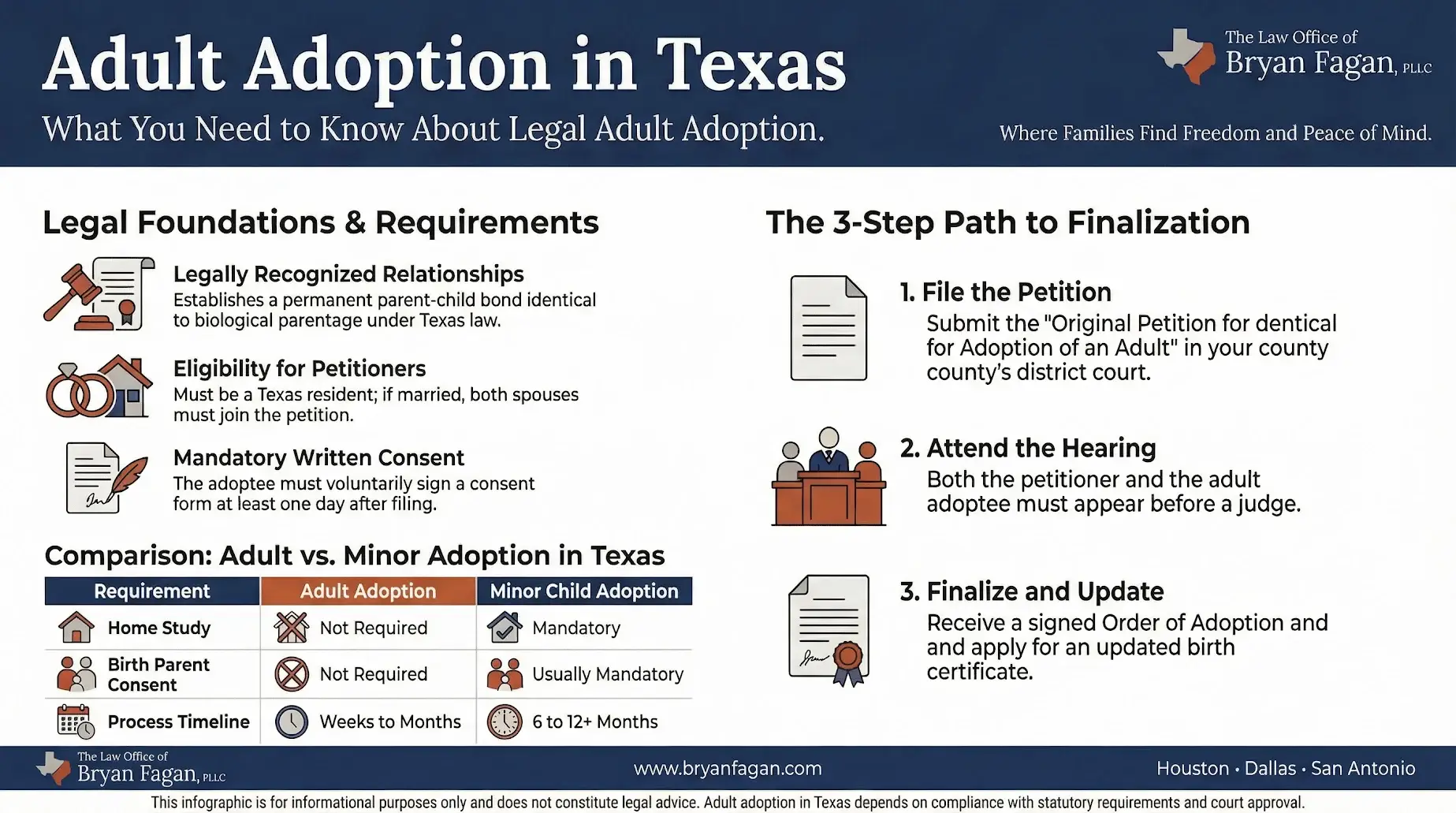
- Adult adoption in Texas is authorized under Texas Family Code §162.501, allowing any person 18 or older to be adopted with their voluntary consent—no biological parents’ approval required.
- The legal process is simpler than minor adoptions, requiring no home study, no termination of parental rights, and typically completing in a single court hearing.
- Adoption creates a full legal parent child relationship, including inheritance rights, medical decision-making authority, and all the associated rights of a biological child.
- Proper consent documentation is essential—the adult adoptee must provide written consent, and spousal consent may be required if the petitioner is married.
- A Texas family law attorney ensures proper filing, protects against challenges, and coordinates any necessary estate planning updates.

Your Family’s Future Starts Here
Don’t navigate your legal journey alone. Schedule a consultation now and get the clarity and support you deserve.
Adult Adoption in Texas: The Legal Basics
Adult Adoption in Texas creates a permanent, legally recognized parent-child relationship between two consenting adults, giving families the ability to align the law with the reality of their lives. Under Texas Family Code §162.501, any adult who is at least 18 years old may be adopted with their written consent. The statute reflects a fundamental principle in Texas law: adults have the legal capacity to choose their family relationships. When a district court signs the final decree, that adoption carries the same legal effect as if the relationship had existed since birth.
Unlike minor adoptions, which require courts to apply the “best interest of the child” standard under Texas Family Code §153.002 and often involve termination proceedings under Chapter 161, adult adoption centers on voluntary agreement. Because the adoptee is legally competent to make their own decisions, Texas courts do not require home studies, CPS investigations, or termination of parental rights. This streamlined process makes Adult Adoption in Texas a practical and powerful option for stepparents, long-term guardians, foster parents, and blended families seeking legal recognition of an already-established bond.
Once the judge signs the Decree of Adoption, the legal transformation is complete. The adopted adult becomes the legal child of the adoptive parent for all purposes under Texas law. That includes inheritance rights under the Texas Estates Code, potential authority in medical decision-making contexts, and recognition in estate planning and beneficiary designations. The legal weight of the decree is significant and enforceable statewide. For families who want a deeper understanding of filing procedures and required documentation, our firm explains the process step by step in this detailed guide on legal requirements and documentation for adult adoption in Texas.
It is equally important to understand what adult adoption does not automatically do. Unlike a minor adoption, adult adoption typically adds a new legal parent-child relationship without automatically severing all biological family ties. However, inheritance rights may shift, and estate planning documents may need to be updated to reflect the new legal reality. Because Texas is a community property state, thoughtful coordination with estate planning strategies is often necessary to avoid unintended consequences.
At The Law Office of Bryan Fagan, PLLC, our approach combines legal precision with compassionate guidance. We understand that adult adoption is rarely just about paperwork. It is about identity, belonging, and long-term security. Families who are also navigating related custody or conservatorship questions can explore our comprehensive Texas child custody resource center to better understand how different areas of Texas family law intersect.

Who Can Adopt an Adult in Texas
Texas law provides a clear framework for families considering Adult Adoption in Texas, ensuring that the process is both legally sound and respectful of meaningful parent-child relationships. Under Texas Family Code §162.501, the adult being adopted must be at least 18 years old and must provide written, voluntary consent. There is no upper age limit. Whether the adult is 22 or 72, Texas courts recognize the right of competent adults to formalize a parental bond that already exists in practice. This reflects the Legislature’s continued commitment to honoring autonomy and family stability under Chapter 162 of the Texas Family Code.
The person seeking to adopt—known as the petitioner—must generally be at least 10 years older than the adoptee and must file the case in a Texas district court. These requirements preserve the integrity of the parent-child dynamic while ensuring the court has proper jurisdiction. Petitioners often include stepparents who helped raise a child after divorce, long-term guardians, former foster parents, or other caregivers who stepped into a parental role during pivotal years. While the statute does not impose a minimum relationship length, judges frequently look for evidence of a genuine, longstanding bond consistent with the purpose of adoption law.
In real-world practice, courts value demonstrated commitment. A stepparent who supported a child through school milestones, a guardian who provided stability during family hardship, or a caregiver who remained present well into adulthood illustrates the type of relationship Texas courts are prepared to recognize through Adult Adoption in Texas. Our legal team regularly assists families in presenting this history thoughtfully and clearly, helping the court understand the depth of the relationship and the importance of formal legal recognition.
Venue and procedural accuracy are equally important. The adoption petition must be filed in the district court of the county where the petitioner resides. Even if the adult adoptee lives elsewhere in Texas, the petitioner’s county controls venue. Careful compliance with filing requirements helps prevent delays and ensures the process proceeds efficiently. Families seeking a detailed breakdown of documentation, consent timing, and court procedures can review our in-depth guide on Adult Adoption in Texas: What It Is and How It Works, which explains each step in clear, practical terms.
If the petitioner is married, Texas Family Code §162.002 generally requires the spouse to join in the petition unless a statutory exception applies. This provision promotes clarity within the marital relationship and helps prevent future disputes involving inheritance or parental rights. Because adult adoption may affect estate planning, community property interests, and beneficiary designations, coordinated legal advice is essential. For broader insight into how adoption intersects with other areas of family law, families may also explore our Texas family law overview.
At The Law Office of Bryan Fagan, PLLC, we approach every case with the understanding that legal processes carry emotional weight. Adult adoption is not simply a procedural step; it is a declaration that a lifelong bond deserves full legal recognition.

Consent Requirements in Adult Adoption Cases
The cornerstone of every adult adoption in Texas is the adult adoptee’s written, voluntary consent. This requirement reflects the fundamental principle that adults have the legal authority to choose their own family relationships.
The adoptee must sign an “Affidavit of Consent to Adoption” or similar consent forms after the petition has been filed with the court. This timing requirement—signing at least one day after filing—helps prevent coercion claims and demonstrates that the adoptee’s decision was freely made.
Spousal consent is required when the petitioner is married. The spouse must join the petition, effectively becoming a co-petitioner in the adoption process.
Here is the crucial distinction from minor adoptions: biological parents’ consent is not required for adult adoption in Texas. Because the adoptee is a legal adult with full decision-making capacity, their consent alone suffices. There is no need to notify, obtain approval from, or terminate the parental rights of biological parents.
This aspect makes adult adoption significantly more straightforward than child adoption, where consent or termination requirements involving biological parents often create delays and complications.
The Legal Process for Adult Adoption in Texas
Filing the Petition
The adult adoption journey begins with filing an Original Petition for Adoption of an Adult in the petitioner’s county’s district court. Texas provides two form sets:
- Set A: For adoptions without a name change
- Set B: For adoptions that include changing the adoptee’s name
Along with the adoption petition, you must file:
- A Civil Case Information Sheet
- A Request to Redact Sensitive Data (to protect Social Security numbers and other identifying information)
- Filing fees, which typically range from $250 to $400 depending on the county
Fee waiver options exist for those who cannot afford court costs. The district court clerk can provide information about eligibility requirements.
After filing, obtain a file-stamped copy of the petition to provide to the adult adoptee for signing their consent.
Court Hearing and Approval
Once the petition and consent forms are properly filed, the court schedules a hearing. Both the petitioner and the adult adoptee must attend. If the petitioner is married, the spouse should also appear.
During the hearing, the judge reviews the petition to verify:
- The adoptee is 18 or older
- Proper consent has been given voluntarily
- The relationship is legitimate and no fraud or undue influence exists
- No legal barriers prevent the adoption
For uncontested adult adoptions with proper documentation, hearings typically last 15 to 30 minutes. The judge may ask brief questions to confirm the parties involved understand what they are doing and that the adoption serves a legitimate purpose.
Upon approval, the judge signs the Decree of Adoption, establishing the legal parent child relationship. This final decree is the official court document that creates your new family relationship under Texas law.
After the decree, you will need to submit a Certificate of Adoption and Texas Birth Certificate Application to the Vital Statistics Unit to obtain a new birth certificate reflecting the adoption.
Legal Effects of Adult Adoption in Texas
When a Texas district court signs a final Decree of Adoption under Texas Family Code §162.505, it establishes a full and permanent parent-child relationship with the same legal force as a biological bond. In the context of Adult Adoption in Texas, that decree is not symbolic. It carries comprehensive legal consequences that affect inheritance, medical authority, and long-term family recognition. The law treats the adopted adult as the legal child of the adoptive parent for virtually all purposes under Texas law, providing clarity and stability for families who have long lived as parent and child in practice.
One of the most significant effects involves inheritance rights. Under the Texas Estates Code, once the adoption is finalized, the adopted adult generally becomes a legal heir in the same manner as a biological child. If the adoptive parent passes away without a will, Texas intestate succession laws apply, and the adopted adult stands on equal footing with any natural-born children. This shift happens immediately upon entry of the decree. Because estate planning implications can be substantial, particularly in a community property state, families often benefit from reviewing wills, trusts, and beneficiary designations after completing Adult Adoption in Texas. Our team regularly guides clients through that process to prevent unintended consequences.
Medical decision-making authority may also be affected. In certain circumstances, a legal parent may have standing to make healthcare decisions if the adopted adult becomes incapacitated, subject to existing advance directives or medical powers of attorney. While adult adoption does not replace proper estate planning documents, it can strengthen legal standing within a family structure and provide added reassurance during medical emergencies.
Another practical benefit involves name changes. Texas Family Code §162.502 permits a court to grant a name change within the adoption proceeding itself. When the appropriate forms are filed and the judge signs the decree, the new name becomes legally recognized without requiring a separate name-change case. This can provide emotional closure and reinforce a sense of identity for many families completing the adoption process.
Federal benefits may also be impacted. In some situations, Social Security survivor benefits or other derivative benefits may become available based on the adoptive parent’s record, though eligibility depends on federal law and specific program requirements. Because these issues intersect with federal regulations, individualized legal guidance is important before making assumptions about qualification.
It is equally important to understand what adult adoption does not automatically do. Unlike minor adoptions that often require termination of parental rights under Texas Family Code Chapter 161, adult adoption typically adds a new legally recognized relationship without automatically severing ties with biological parents. The adopted adult may maintain personal connections with biological family members while also enjoying the legal rights that flow from the new parent-child relationship. For families who want a deeper explanation of the legal reasoning behind these outcomes, our detailed article on Adult Adoption in Texas: Why, When, and How Does It Work offers additional insight.
At The Law Office of Bryan Fagan, PLLC, our mission is to educate families and protect futures. We understand that legal recognition carries emotional meaning. Whether you are formalizing a lifelong stepparent bond or strengthening family unity later in life, we approach every Adult Adoption in Texas case with clarity, compassion, and precision. Families navigating related custody or support questions may also find helpful information in our Texas child custody resource center, which explains how various areas of Texas family law work together to safeguard long-term stability.

Adult Adoption and Inheritance Rights
One of the most significant legal implications of adult adoption involves inheritance rights under Texas law. Understanding these effects is essential for everyone involved.
Upon adoption, the adult adoptee becomes a Class A heir under the Texas Estates Code. In practical terms, this means:
- If the adoptive parent dies without a will (intestate), the adopted adult shares equally with any biological children
- The adopted adult gains homestead rights and wrongful death recovery rights
- The adopted adult can inherit from the adoptive parent’s estate just as any other family members would
Existing wills and trusts require review. If the adoptive parent has estate planning documents that do not specifically address the newly adopted adult, unintended consequences may result. Some documents may automatically include adopted children; others may inadvertently exclude them.
Consider this scenario: A stepparent adopts their spouse’s 40-year-old child. Without updating their will, the stepparent’s estate could be divided in ways they never intended—potentially creating conflict with other adult children from prior relationships.
Coordination with an estate planning attorney is strongly recommended following any adult adoption. Approximately 40% of adult adoptions cite estate planning as a primary motivation, according to family law practitioners, making this coordination particularly important.
Can Adult Adoption Be Challenged or Reversed?
Once a Texas court enters a Decree of Adoption, the order is final and presumptively valid. Adult adoption creates a permanent legal relationship that is difficult to undo.
Challenges to an adoption decree are limited to narrow grounds:
- Fraud: If someone misrepresented material facts to obtain the adoption
- Duress or coercion: If the adoptee’s consent was not truly voluntary
- Lack of consent: If proper consent was never actually given
A party seeking to challenge an adoption would need to file a petition for bill of review or annulment, typically within two to four years of the decree. Courts uphold the vast majority of uncontested adoption decrees—over 95% according to available data.
This finality underscores why proper legal procedure matters. Ensuring that consent forms are properly executed, that all parties involved understand the process, and that documentation is complete protects the adoption against future challenges.
A rare 2023 case in Dallas County involved a reversal based on forged consent documents—highlighting exactly why the timing requirements for consent signatures and proper attestation exist.
Common Reasons for Adult Adoption in Texas
Families pursue adult adoption for diverse reasons, each reflecting the unique circumstances that bring people together:
Formalizing stepparent relationships represents the most common scenario. A stepparent who raised a child from a young age may not have adopted during childhood for various reasons—perhaps the biological parent was still living, or circumstances simply did not allow it. Once the child reaches adulthood, stepparent adoption provides the legal recognition that matches the emotional bonds that already exist.
Recognizing foster parent or guardian connections is another frequent motivation. Foster care involvement sometimes creates lifelong relationships that families wish to formalize once the former foster child reaches adulthood.
Estate and inheritance planning motivates many adult adoptions, ensuring that chosen family members have inheritance rights and legal standing within the family structure.
Emotional security and affirmation should not be underestimated. For many families, the legal procedure provides closure and validation of relationships that have existed for years or even decades.
LGBTQ+ families have increasingly utilized adult adoption to formalize chosen family relationships, particularly in circumstances where other family law cases may not have applied or where emotional bonds developed outside traditional family structures.
Common Myths About Adult Adoption in Texas
Myth 1: Adult Adoption is Only for Inheritance
The truth: While inheritance planning motivates many adoptions, adult adoption creates a complete legal parent child relationship with far broader implications. It affects medical decision-making authority, legal standing in family matters, and the emotional benefits of recognized family membership. The legal relationship established is identical to that between a biological parent and child.
Myth 2: You Need Biological Parents’ Approval
The truth: Under Texas law, biological parents do not need to consent to an adult adoption. Because the adoptee is a legal adult with full capacity to make their own decisions, their voluntary consent is sufficient. This differs fundamentally from child adoption, where biological parent consent or termination of parental rights is required.
Myth 3: It’s Just Symbolic with No Legal Impact
The truth: Adult adoption is absolutely not symbolic. The Decree of Adoption creates legally enforceable rights and obligations. The adopted adult gains inheritance rights, the adoptive parent gains medical decision-making authority in certain circumstances, and the relationship is recognized for social security benefits, wrongful death claims, and other legal purposes.
How a Texas Family Law Attorney Helps With Adult Adoption
Although the process for Adult Adoption in Texas is generally more straightforward than adopting a minor, strict compliance with the Texas Family Code remains essential. Texas Family Code §162.501 governs adult adoption and requires the adoptee’s written, voluntary consent. The court must also enter a final decree under §162.505 before the parent-child relationship becomes legally binding. Even small procedural missteps—such as incomplete petitions, improperly executed consent forms, or incorrect venue—can delay approval or require refiling. An experienced Texas family law attorney ensures that every document complies with current statutory requirements and reflects the latest updates to Chapter 162.
Consent is not simply a formality. Under §162.502, the court must be satisfied that the adult’s consent is voluntary and legally valid before granting the adoption. Proper drafting and timing protect the adoption from later challenges based on coercion or procedural defects. Our legal team carefully prepares and reviews all pleadings and supporting documents to safeguard the integrity of the final decree and provide families with lasting legal security.
While adult adoptions do not require home studies or termination of parental rights under Chapter 161, judges still examine jurisdiction, statutory compliance, and the authenticity of the parent-child relationship. Understanding how courts interpret these provisions reduces stress and allows families to approach the hearing with clarity and confidence. For a deeper explanation of how the courts evaluate these cases, families can review our detailed guide on Adopting an Adult in Texas, which walks through the process step by step.
Adult adoption often intersects with inheritance rights under the Texas Estates Code and community property principles unique to Texas law. Adding a legally recognized child can affect wills, trusts, and beneficiary designations, particularly in blended families. Our attorneys routinely advise clients on coordinating adoption with estate planning to prevent unintended consequences. Families seeking a broader understanding of how adoption fits within the larger framework of Texas law can explore our comprehensive Texas family law resource center.
Securing a legally enforceable decree under §162.505 is the final—and most meaningful—step. At The Law Office of Bryan Fagan, PLLC, our mission is to educate families and protect futures. For those considering Adult Adoption in Texas, skilled legal guidance transforms a procedural filing into a confident step toward permanence, clarity, and long-term peace of mind.

Why Choose The Law Office of Bryan Fagan, PLLC
The attorneys at The Law Office of Bryan Fagan, PLLC bring extensive experience handling Adult Adoption in Texas, grounded in a thorough understanding of Texas Family Code Chapter 162. Sections such as §162.501, which authorizes adult adoption with written consent, and §162.505, which governs entry of the final decree, provide the legal foundation for these cases. Our firm remains attentive to the latest updates to the Texas Family Code to ensure every petition, consent form, and decree complies with current statutory requirements and local court procedures.
Our approach blends legal precision with compassionate, family-centered advocacy. We understand that adult adoption is rarely about paperwork alone. It represents the formal recognition of a bond that has often existed for years—sometimes decades. Whether formalizing a stepparent relationship formed after divorce or securing inheritance clarity for blended families, we guide clients through the process with clarity and confidence. For those seeking a deeper explanation of how the procedure works from filing to final hearing, our detailed resource on Adopting an Adult in Texas offers practical insight into the steps involved.
Why do we do this work? Because we believe families deserve legal recognition that matches their lived reality. Texas law provides the mechanism through Adult Adoption in Texas, and our mission is to help clients use that mechanism wisely and effectively.
How do we serve our clients? Through clear legal education, compassionate counsel, and carefully prepared documentation that protects your family’s long-term interests. Adult adoption can intersect with estate planning, community property considerations, and inheritance rights under the Texas Estates Code. We regularly coordinate these issues to ensure that the final decree aligns with your broader legal and financial goals.
What do we provide? Comprehensive adult adoption representation from initial consultation through court approval, including guidance on venue, consent timing, name changes under §162.502, and post-decree planning considerations. Families navigating related custody or conservatorship issues can also explore our Texas child custody resources to better understand how different areas of Texas family law intersect.
With offices serving clients throughout Texas—including Houston, Dallas, San Antonio, Austin, and surrounding communities—our team is committed to educating families and protecting futures statewide. When you are ready to formalize a meaningful lifelong relationship, our experienced Texas family law team stands ready to guide you every step of the way.
Checklist: Adult Adoption in Texas
Use this checklist to prepare for your adult adoption journey:
- ☐ Confirm the adoptee is 18 years of age or older
- ☐ Verify the petitioner is at least 10 years older than the adoptee
- ☐ Confirm Texas residency for the petitioner
- ☐ Obtain written consent from the adult adoptee (signed after petition filing)
- ☐ Review marital status and obtain spousal consent if petitioner is married
- ☐ Gather required documents including identification and residency verification
- ☐ Consider whether a name change will be requested
- ☐ Review existing estate planning documents for needed updates
- ☐ Consult with a Texas family law attorney before filing
Conclusion
Family transitions can feel overwhelming, especially when you are trying to protect your child’s emotional well-being and academic future at the same time. Whether you are navigating divorce, adjusting a custody arrangement, or exploring Adult Adoption in Texas to formalize a lifelong bond, the common thread is stability. Children thrive when they feel secure, supported, and seen. And parents gain peace of mind when they know they have taken thoughtful legal steps to protect that stability.
The good news is that you do not have to figure it all out alone. Texas family law provides tools designed to safeguard children’s best interests, preserve educational continuity, and strengthen meaningful family relationships. The key is understanding how those tools work and applying them with care. An experienced Texas Family Law Attorney can help you build a strategy that supports your child’s academic success while protecting your rights and long-term goals.
At The Law Office of Bryan Fagan, PLLC, we believe legal guidance should feel empowering, not intimidating. Our team is here to answer your questions, explain your options clearly, and help you move forward with confidence. If you are facing a custody issue, concerned about your child’s performance in school, or considering adult adoption to honor a bond that has already stood the test of time, we invite you to reach out and schedule a consultation.
Sometimes the most important question is not “What happens next?” but “What future do I want to create for my family?” When you are ready to take that next step, we are here to help you protect what matters most.
Adult Adoption in Texas – Frequently Asked Questions
In Texas, the cost of an adult adoption typically includes court filing fees, which often range from a few hundred dollars depending on the county, plus fees for certified copies and updated vital records. If you hire an attorney, legal fees will vary based on the complexity of the case and whether additional steps, such as a name change, are included. Many families find that working with an experienced Texas Family Law Attorney helps prevent delays or costly refiling due to paperwork errors.
Adoption and tax dependency are separate legal issues. Adult Adoption in Texas creates a legal parent-child relationship under state law, but it does not automatically make the adopted adult your tax dependent. Dependency is determined by federal IRS rules, which consider income, financial support, and residency. If tax planning is part of your goal, it’s wise to consult both a family law attorney and a qualified tax professional.
Yes, under Texas law, a U.S. citizen may adopt a 30-year-old adult as long as the legal requirements are satisfied and the adult consents. However, adult adoption does not typically provide immigration benefits such as automatic citizenship or a green card. Immigration matters are governed by federal law and are treated differently from state adoption laws.
Generally, no. Texas law typically requires that the adoptive parent be older than the adult being adopted, with a minimum age difference. Courts expect the relationship to resemble a traditional parent-child dynamic. If the age difference requirement is not met, the adoption may not be approved.
Texas law does not require you to hire a lawyer for adult adoption, but many people choose to do so. The process is simpler than minor adoption, yet mistakes in filing, consent timing, or court procedures can cause delays. An experienced Texas Family Law Attorney can ensure that the petition, consent documents, and final decree are properly prepared and that your adoption is legally secure.
There is no maximum age limit for Adult Adoption in Texas. As long as the person being adopted is at least 18 years old and can voluntarily consent, the court may approve the adoption. Adult adoptions often occur in a person’s 20s, 30s, 40s, or even later in life to formalize a long-standing stepparent or caregiver relationship.
Many adult adoption cases in Texas are completed within one to two months, depending on the county and court schedule. Once the petition is filed and proper written consent is submitted, the court will schedule a hearing. In uncontested cases with correct documentation, the hearing itself is usually brief.
Possibly, but not automatically. Federal tax law—not adoption law—determines whether someone qualifies as a dependent. Factors include how much financial support you provide, the person’s income level, and IRS “qualifying relative” rules. Adoption alone does not guarantee dependent status.
For many families, the purpose of Adult Adoption in Texas is to align the law with reality. It can formalize a lifelong stepparent bond, secure inheritance rights, allow for a legal name change, and strengthen family identity. Beyond legal benefits, adult adoption often provides emotional closure and affirmation—especially for individuals who grew up in blended families or experienced divorce.